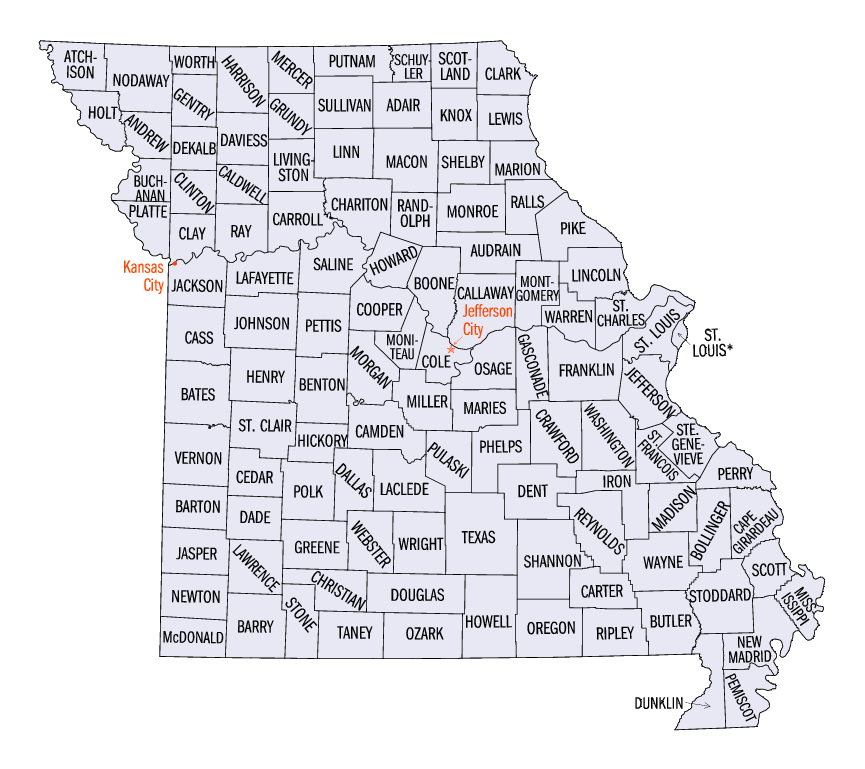
Missouri
Victims of the State
32 Cases
County/City: Boone
Buchanan Camden
Cass Christian
Clay Cole
Franklin Greene
Jackson Jefferson
Lawrence Livingston Reynolds
St. Louis City St.
Louis County
Ryan Ferguson and Chuck Erickson were convicted of the brutal
murder of Columbia Tribune sports editor Kent Heitholt. A
janitor, Jerry Trump, caught a glimpse of two young white men running away
from Heitholt's car around the time of the murder. The janitor said he
could not provide a detailed description of them. Two years after the
crime, after reading anniversary newspaper coverage, Erickson began telling
friends he dreamed he had killed Heitholt.
Read More by Clicking Here
After being interrogated for 13 hours, Melvin Lee Reynolds, a mentally handicapped adult, confessed to the abduction and murder of four-year-old Eric Scott Christgen. Reynolds allegedly enticed Christgen from a shopping mall in St. Joseph, Missouri, took him to a wooded area, sexually molested him, and then killed him by asphyxiation or suffocation. Reynolds was convicted and sentenced to life in prison. He was exonerated in 1983 after Charles Hatcher, a serial killer, who had murdered several other people after Reynolds' conviction, contacted authorities and confessed to the crime. Reynolds' case and Hatcher's homicides are profiled in the book Innocent Blood by Terry Ganey (NY Times) [10/05]
Sandy Lynn Hemme was convicted of murdering Patricia Jeschke due to a confession that was extracted from her when she was delusional. (IIPPI)
Danny Wolfe was convicted of murdering Leonard and Lena Walters and sentenced to death. The conviction based on the testimony of eyewitness Jessica Cox. Hair evidence thought at trial to belong to Wolfe has been determined to belong to Cox, a fact that supports the defense argument that Cox was framing Wolfe. Robert Morgan, a friend of Leonard Walters, claimed to have had coffee with Walters after Cox claimed he was dead. Morgan's statement is more consistent with autopsy results. Wolfe's conviction was overturned in 2003, but he was reconvicted at a retrial in 2006. (AP News) (Missourian) [11/05]
Jennifer Hall was convicted of arson after fire investigators failed to notice an obvious electrical short. At sentencing her attorney pressured her to take responsibility for the fire, as the court would look more favorably on her. Although Hall had never smoked, she related a story of starting the fire accidentally by dropping a cigarette. Hall's second attorney hired an expert who found the obvious short. A judge overturned Hall's conviction in 2004, a week after she was paroled. Despite having served her time, the prosecutor retried her in 2005. Hall's family felt this was done out of spite. The retrial jury found her “not guilty.” (JD) [2/07]
George S. Revelle, the CFO of Ozark Bank, was convicted of murdering his wife, Lisa, at their home in Fremont Hills. Revelle told authorities that intruders broke into their home and shot his wife in a bungled extortion attempt. He was convicted because he had a $500,000 life insurance policy on his wife and an old letter in which she criticizes him for being materialistic.
Five months into the investigation, the apparent murderers sent a confession letter to police. They said they were fugitives living outside the U.S. They stated George's stepbrother had originally approached them about kidnapping George and forcing him to go to his bank so they could rob it. The letter writers revealed the location of a pond where the murder weapon was found. The prosecutor never investigated any of this evidence, except to test the stamp on the letter envelope for Revelle's DNA.
Revelle's conviction was overturned in Nov. 1997 because an appeal's court found that his wife's note should not have been allowed as trial evidence. On retrial in Dec. 1998, Revelle was acquitted. (Beyond the Yellow Ribbon) (Google) [4/08]
Clarence Dexter, Jr. was convicted of murdering his wife of 22 years, Carol. Police overlooked evidence that the murder occurred in the course of a botched robbery and decided that Dexter must have committed the crime. Dexter's trial lawyer, who was in poor health and under federal investigation for tax fraud, failed to challenge blood evidence presented at trial. The conviction was overturned in 1997 because of prosecutorial misconduct. The defense then had the blood evidence carefully examined and showed that the conclusions presented at trial were completely wrong. The state's blood expert admitted that his previous findings overstated the case against Dexter. On the eve of Dexter's retrial in 1999, the prosecution dismissed the charges and Dexter was freed. [9/05]
In response to a prison riot at Missouri State Penitentiary, authorities shot four inmates to death and wounded another 30. Most were apparently inmates who had fled the riot. None of the inmates were armed. (Crime Magazine) [9/05]
During a prison riot at Missouri State Penitentiary, the prison's most notorious stool pigeon, Walter Lee Donnell, was murdered by one or more inmates. Donnell had testified against many members of a St. Louis armed robbery clique including Irv Thomas. These obvious suspects were not even questioned about Donnell's death. Instead, the leaders of the riot were tortured into confessing to the murder. When a smaller riot occurred in October, its leader was also tortured into confessing. The prison authorities wanted to send a message: “Cause trouble and you will be forced to confess too.” All seven were convicted of the murder, but a look at the evidence gives little reason to believe the confessions. The real killer, Irv Thomas, had his sister release his confession to the killing upon his death in 1981. (Crime Magazine) [9/05]
Lloyd Schlup was convicted of murder in the stabbing death of Arthur Dade, a fellow inmate at the Missouri State Penitentiary. Dade, a black inmate, was stabbed to death in a crowded cellblock by Robert O'Neal, a hit man for the Aryan Brotherhood, a white prison gang. Two prison guards testified that Schlup held Dade while O'Neal did the stabbing. Schlup was sentenced to death. Numerous eyewitnesses knew Schlup had not participated the crime, but investigators had not questioned them. After Schlup's execution was scheduled in 1993, the victim's mother called the Missouri Governor saying she did not believe Schlup killed her son. Her emotional appeal was helped by an Inside Edition report that brought national attention to the case. Schlup's conviction was overturned. Rather than face trial in 1994, he took a plea deal that would not interfere with his ability to seek parole in 2003 on the assault charge for which he was originally imprisoned. (Schlup v. Delo) (Time) [10/05]
Joseph Amrine was convicted of murdering another prisoner, Gary Barber, at the Missouri State Penitentiary in Jefferson City. Amrine was sentenced to death. He was convicted on the testimony of three jailhouse snitches, in spite of a prison guard testifying that one of the snitches was the actual killer. Six other inmates stated that Amrine was elsewhere in the prison, playing cards at the time. The three snitches later admitted they lied to escape relentless rape or prosecution for the prison murder. The case is the subject of a documentary, Unreasonable Doubt: The Joe Amrine Case. During Amrine's appeal to the Missouri Supreme Court, the prosecution argued that Amrine should be executed even if the court found him innocent, but the court established “actual innocence” as a Missouri standard that allowed it the right to overturn convictions that contained no technical errors. The court overturned Amrine's conviction in 2003 and prosecutors released him three months later after they decided not to retry him for the crime. (KC Star) (JP) [12/06]
Jerry Lynn Parker was convicted of sexually molesting three girls, K.B., age 10, H.R., age 11, and B.C., age 13. He was sentenced to 195 1/2 years of imprisonment. The girls said they were kidnapped at gunpoint from a gazebo in Gerald City Park and forced to walk to a woman's rest room about a block away where they were molested. The girls' story contains numerous implausible or impossible details. A deputy indicated that he did not believe the story. Police undertook no further action on the girls' report until two weeks later when Parker became a suspect. At trial, on cross examination, the Gerald Police Chief conceded his office received over 50 leads and the names of three suspects regarding the alleged assault but Parker was the only person ever questioned about it. Read More by Clicking Here
Eric Darnell Clemmons was convicted of the murder of Henry Johnson, a fellow prisoner at the Missouri State Penitentiary. Clemmons had been cellmates with Johnson, but was moved to a different cell on July 1, 1985 after he accused Johnson of making sexual advances towards him. There was no reported trouble between the two following the move. This move occurred more than a month prior to Johnson's murder. Prison guard Thomas Steigerwald testified that as he was walking towards a group of inmates, he saw an inmate strike Johnson. Johnson then ran past Steigerwald, at which point, Steigerwald realized that Johnson had been stabbed. Steigerwald then pursued the inmate who struck Johnson. This inmate turned out to be Clemmons.
According to Clemmons, Steigerwald did not witness the stabbing, but had merely seen Johnson running into him after he had been stabbed by inmate Fred Bagby. Several other inmates testified that Bagby had stabbed Johnson. Following Johnson's stabbing, Bagby himself was stabbed three months later and died prior to trial. The State argued that the testimony of Clemmons' witnesses should be discounted because it was easy for them to try to help Clemmons by blaming someone who could not defend himself. Handling his own appeal, Clemmons discovered an internal DOC memorandum that had been withheld from his defense in violation of Brady v. Maryland. The memo related that minutes after Johnson's stabbing, an inmate named Dwight Clark had told a guard captain that two men had performed the stabbing. Clark thought one inmate was Fred Bagby, but the other inmate he only knew by sight. On retrial in 2000, Clemmons was acquitted. (Google) [4/08]
Armand Villasana was convicted of the kidnapping and rape of Judith Ann Lummis. Lummis, who was white, had described her assailant as a Hispanic in his early 20s. She identified Villasana from a photo lineup that contained five white men and himself, the only Hispanic. However, Villasana was 45 years old. Following conviction, DNA tests produced the profile of an unknown male, results which exonerated Villasana in 2000.
In 2005, the unknown DNA profile was matched to a prisoner in the Ozark Correctional Center. When interviewed the prisoner said that he was having an affair with Lummis at the time of her alleged rape, and had sex with her the very night she reported the rape. According to the prisoner, after Lummis's husband questioned why she was late getting home, she made-up her kidnapping and rape story on the spur of the moment so her husband wouldn't find out she was cheating on him.
Investigators were initially unsuccessful at locating Lummis to confirm the story as she was on probation and had skipped reporting. However, a background check revealed that Lummis had made a nearly identical kidnapping report in Aurora, Missouri against another man that was proven to be false prior to his trial. After Lummis was arrested for violating her probation, she confirmed in 2007 that her accusation against Villasana was a hoax. Lummis cannot be prosecuted for perjury as the statute of limitations for it had run out. (JD) (IP) [5/08]
Darlene Edwards, 43, Frank Sheppard, 46, Earl “Skip” Sheppard, 37, Bryan Sheppard, 26, and Richard Brown, 26, all Native Americans, were convicted of setting a fire that caused an explosion and killed six firefighters. The fire occurred at a site associated with the construction of a ten-mile road. Two trailers on the site contained 50,000 pounds of construction explosives. The explosion had 5 times the impact of the Oklahoma City bomb, evaporated a fire department pumper, and was heard 45 miles away. As late as 1995, ATF agents said on the TV show Unsolved Mysteries that the fire was set by organized labor to teach the general contractor a lesson for using non-union labor. But the demand for closure and $50,000 reward money led police and prison snitches to finger five indigent Native Americans who had nothing to do with organized labor. (Crime Magazine: Part 1 Part 2) (kcfirefighterscase.com) [9/05]
Richard Stallings was convicted of the murder of Donna Meredith. Physical evidence from the crime scene was either not investigated or results about it were withheld. Witnesses with axes to grind testified against Stallings. (JD) (State v. Stallings) [2/07]
Byron Christopher Case was convicted of the murder of
18-year-old Anastasia WitbolsFeugen. He was sentenced to life imprisonment
without parole. On the night of her alleged murder, Anastasia had been with her
boyfriend, Justin Bruton, 18, and another couple, Byron Case, 18, and Kelly
Moffett, 15. The four had met at around 8:30 p.m. According to Byron and
Kelly, Anastasia was angry at being picked up three hours late, got into an
argument with Justin, and soon left the vehicle at a stoplight. Anastasia
was found shot dead at 3:45 a.m. that night in a nearby cemetery. Justin never talked to the police and less than 48 hours
later, he was found shot dead 30 miles away from a self-inflicted gunshot
blast to the head.
Read More by Clicking Here
Walter Hess and Alvin Craig were convicted of the murder of Virgil Romine, an attendant at a restaurant associated with the Artesian Park filling station near St. Louis. After being shot and prior to his death, Romine mistakenly claimed that his assailants were the same fellows who put slugs in a restaurant slot machine some weeks before. Upon being visited by the police, Hess and Craig readily admitted they were the ones who had slugged the restaurant's slot machine. However, they denied any knowledge of the murder. Attempts at trial to ban hearsay testimony regarding what Romine said about his assailants were denied on the grounds that Romine gave a dying declaration. A year after the defendants' convictions the real perpetrators were identified and convicted. Missouri Governor Caulfield then pardoned Hess and Craig on the grounds that they were innocent. (CTI) [6/08]
Johnny Lee Wilson was convicted of the murder of 79-year-old Pauline Martz. Martz had been beaten up, tied, and then burned after her home was set on fire. Wilson, a mentally retarded man, had confessed to the crime after a police interrogation. In 1988, another man, Chris Brownfield, gave a confession to the crime which provided details that corroborated his involvement. Wilson was pardoned and released in 1995. (U.S. News) [4/08]
Mark Woodworth was convicted of the murder of Catherine Robertson and the attempted murder of her husband, Lydel Robertson. (JD)
Joseph Huett, a lawyer, was charged with the shooting murder of Raoul Hunter, a sawmill worker. Along with Huett, Huett's wife and Lee Bowles, a justice of the peace, had been present during the killing. At trial Bowles testified that Huett killed Hunter without provocation because of a long-standing political feud. The jury convicted Huett of manslaughter and he was sentenced to five years of imprisonment. Seven months later Bowles admitted he perjured himself because Hunter had been his friend and “I hated Huett.” Hunter had actually been gunning for Huett who shot him in self-defense. Shortly after Bowles' admission, Huett was released from prison. (Not Guilty) (News Article) [6/08]
Louis DeMore joked to police on the street that he fit the description of a wanted killer and he was arrested. In May 1934, DeMore confessed and pleaded guilty to the murder of Patrolman Albert Siko to escape the death sentence that police threatened him with if he went to trial. Gov. Park pardoned DeMore in Oct. 1934 after police caught another man, George Couch, who was found with Siko's revolver and confessed to being the real killer. (The Innocents) [10/05]
Larry Griffin was convicted and sentenced to death for the murder of Quintin Moss. Moss was killed in a drive-by shooting while allegedly dealing drugs on a St. Louis street corner. The conviction was based largely on the testimony of Robert Fitzgerald, who had been at the scene of the killing. He testified at trial that he saw three black males in the car from which the shots were fired and that he could identify Griffin as one of them. He testified that Griffin shot at the victim through the window of a car with his right hand. Griffin's lawyer, a recent law school graduate, had never tried a murder case. The lawyer did not challenge this testimony, even though Griffin was left-handed.
Griffin's fingerprints were not found on the car or weapons. All evidence against him was circumstantial. Evidence suggests that Fitzgerald was promised a reduced sentence in exchange for his testimony. The jury was not provided with this information. Fitzgerald later recanted his testimony. He said the investigating officers showed him a photograph of Griffin and told him, “We know this man is involved.” Fitzgerald was then presented with five photos from which he identified Griffin. Griffin's lawyer failed to investigate an alibi witness. The prosecution was able to bring out that the alibi witness had erred about the day he and Griffin had been together, thus making it appear that the alibi had been fabricated.
The prosecution failed to reveal that there were two additional eyewitnesses who confirmed that Griffin was not involved in the murder. The first testified that he witnessed the shooting, and he did not recognize any of the three men who killed the victim. He knew Griffin and was certain that Griffin was not in the car with the shooters. The other witness, a 16-year-old member of a gang led by Griffin's brother at the time of the murder, also testified that Larry Griffin was not involved in the shooting and named the three men who were all members of the gang led by Griffin's slain brother. He was able to describe the exact sequence of events leading to Moss's murder and to testify to the killers' motive. He also was able to identify correctly the place where the car and guns had been abandoned and later found by the police.
Despite the compelling evidence of Griffin's innocence, appeals courts upheld his conviction and death sentence. Griffin was executed by lethal injection on June 21, 1995. (EJ USA) [1/07]
Anthony D. Woods was convicted of raping a 15-year-old girl. The victim was sure Woods raped her, even though she initially described her assailant as four years older, four inches shorter, and skinnier than Woods. She also had said her assailant had a beard, but Woods had no hair between his mustache and “chin fuzz.” Woods' attorney noted that the girl did not pick Woods out of a book of hundreds of photographs that police showed her after she was raped. Instead, she picked the first unknown man to walk by her house that day. DNA tests exonerated Woods in 2005. (IP) [6/05]
Larry Johnson was convicted of raping and sodomizing a St. Louis University student. The victim described her assailant as clean-shaven, but Johnson had a mustache. Post-conviction defense actions beginning in 1996 by the Innocence Project faced years of intense resistance from the Circuit Attorney and others who would not even verify the existence of biological evidence. In 2002, the IP eventually got a court to order DNA evidence testing from the state crime laboratory. The order specified that the lab was to give results simultaneously to the Innocence Project and the Circuit Attorney. The Associated Press first notified the IP and told them that the Circuit Attorney had scheduled a press conference that day to announce that DNA testing exonerated Larry Johnson. Johnson served 18 years of a life-plus-15-years sentence. (IP) [7/05]
Lonnie Erby was convicted of raping three girls, ages 14 to 16, in separate incidents. Each victim had identified Erby as her assailant. In 2003, DNA tests exonerated him of committing two of the rapes. There was no semen evidence for the third rape, as the victim had bathed before it could be collected, but officials accepted the premise that Erby was innocent of committing this rape as well. Erby was freed after serving 17 years in prison. (IP) (Post-Dispatch) [12/05]
Antonio Beaver, a black man, was convicted of robbing a 26-year-old white woman in a St. Louis parking lot. The victim initially described her assailant as a 5'10" clean-shaven black man with a David Letterman like gap between his teeth. The assailant stole her purse and also her car, which was recovered the next day in East St. Louis. The victim also noticed that the assailant was bleeding while he was inside her car. A week later, a detective arrested Beaver because he thought Beaver resembled the composite sketch in the case. However, Beaver was 6'2", had a full mustache, and had chipped teeth. Nevertheless, the victim identified him in a four-person lineup.
At trial, Beaver's defense argued that Beaver could not have been the perpetrator since fingerprints collected from the driver's side of the car and from the rearview mirror did not match him. However, Beaver was convicted and sentenced to 18 years in prison. In 2001, Beaver filed a motion for DNA testing of the blood evidence. It was not until Oct. 2006 that the state agreed to this testing. After test results came back, Beaver was exonerated and he was released in March 2007. (IP) [7/07]
Steven Toney was sentenced to life in prison for a 1982 rape. After a federal appeals court ruled that Toney had a right to DNA testing, Centurion Ministries paid for the tests that proved his innocence. The county prosecutor had fought the petition for new tests, insisting that two eyewitnesses had identified him. When the test results were revealed, the prosecutor urged Toney's immediate release, which occurred in 1996. (CM) (IP) [5/05]
Johnny Briscoe was convicted of rape and burglary after the assailant told the victim his name was John Briscoe. The assailant, who apparently was an acquaintance of Briscoe named Larry Smith, also called the victim several times following the attack, while police were still present, identifying himself as John Briscoe. The calls were traced to a payphone near Briscoe's apartment. The victim identified Briscoe as her assailant in a photo lineup and in a live lineup. A search of the physical evidence by Centurion Ministries turned up a cigarette butt smoked by the assailant, which was found to contain Smith's DNA. Briscoe was released in 2006. Smith is serving a life sentence for a separate sexual assault at the same apartment complex involved in Briscoe's case. (IP) (KSDK 5) (CM) [12/06]
Ellen Maria Reasonover was convicted of the murder of James Buckley, a 19-year-old gas station attendant. The murder occurred at a Vickers gas station on West Florissant Avenue in Dellwood. Reasonover had been at a 7-Eleven convenience store across the street from the gas station at the time of the murder. After hearing about the murder on the news, she tried to be a Good Samaritan by calling police and telling them of the two men who had left the scene in a car. Instead of being appreciative of her information, police focused on her as the murderer. Reasonover's conviction was based on the testimony of two drug-addicted career criminals. Centurion Ministries' investigation showed they had received secret deals from the prosecutor. A federal judge ruled that prosecutor Steven Goldman hid evidence clearly showing that the criminals' testimony was false. Reasonover was freed in Aug. 1999 and later awarded $7.5 million. (JD#1) (JD#2) (CM) [7/05]
Sandra Kemper confessed to starting a house fire that killed her 15-year-old son after she was told that she failed a lie detector test. The defense argued the confession was coerced. The trial judge allowed evidence of the lie detector test into the trial. The defense argued that it showed an 88 percent probability she was telling the truth. The judge then declared a mistrial because he changed his mind about the admissibility of the test. In 2006, the Missouri Supreme Court ruled that Kemper cannot be retried, as a retrial would violate the law against double jeopardy. (Appeal) [9/06]