Wife Murder CasesIncludes Live-In Girlfriends
Main Menu |
Blount County, AL |
Bill Wilson |
Late 1908 |
|---|---|---|
|
In 1908, Bill Wilson's wife, Jenny, divorced and left him. She took their 19-month-old child with her. In 1912, the skeletal
remains of an adult and child were discovered by the Warrior River. As
news of the discovery spread, many area residents, presuming the remains to
be ancient, visited the site in the hope of finding Indian relics. | ||
Coffee County, AL |
George White |
Feb 27, 1985 (Enterprise) |
|---|---|---|
|
Both George W. White and his wife Charlene were shot multiple times by a masked gunman. George survived but Charlene died. Sixteen months later George was charged with the murder of his wife. Following a trial that was later characterized as a mockery and a sham, George was convicted and sentenced to life in prison. In 1989, the conviction was overturned after George spent over 27 months in prison. In 1992, the charge was dismissed after proof of George's innocence surfaced. George is a co-founder of Citizens United for Alternatives to the Death Penalty and served on the board of Murder Victims Families for Reconciliation from 1994 to 1998. (Journey of Hope) (Justice: Denied) [6/05] | ||
Marshall County, AL |
Randall Padgett |
Aug 17, 1990 |
|---|---|---|
|
Larry Randall Padgett was sentenced to death for the murder of his estranged wife, Cathy Padgett. Cathy had been stabbed 46 times, after an apparent rape. DNA tests showed that Randall's semen was found in Cathy's body. The defense argued that a neighbor, Judy Bagwell, with whom Randall had been having an affair, killed Cathy, and put Randall's semen inside her. Blood was found at the scene of the crime that did not match Cathy's. The prosecution withheld blood typing tests done on this blood from the defense. Following Randall's conviction, it was determined that the blood did not match Randall's, and thus had to have come from a third person. In 1995, the Court of Criminal Appeals overturned Randall's conviction, ruling that prosecutors didn't give the defense adequate time to review the blood evidence. Randall was acquitted on retrial in 1997. (PC) [7/05] | ||
Mobile County, AL |
Donnie Mays |
Apr 12, 2001 (Mobile) |
|---|---|---|
|
Donnie Mays was convicted of the murder of his wife Kaye. On the day of Kaye's death, Donnie, who worked for American General Auto
Finance, received a phone call from corporate headquarters telling him that
someone had forged his signature on expense reports. Kaye subsequently
admitted she had forged Donnie's signature. Not knowing the severity
of the wrongdoing or that Kaye had actually stolen money from his employer,
Donnie suggested they call his boss, Jim Martin, whom both Donnie and Kaye
were close to. However, Kaye decided it would be best to wait until
the following morning. | ||
Shelby County, AL |
Patrick Swiney |
Dec 10, 1987 |
|---|---|---|
|
Patrick Swiney was convicted of murdering his wife, Betty Snow
Swiney, and her ex-husband, Ronald Pate. One night, when Swiney was
approaching his house, he blacked out, stating that he felt as though he'd
been hit on the head with a baseball bat. He awoke in his house with a
serious bruise on his head and with the rifle he kept in his truck lying
near him. He found his wife and her ex-husband lying on the floor, shot dead
with bullets assumed to have been fired from the rifle. | ||
Kern County, CA |
Patrick Dunn |
July 1, 1992 |
|---|---|---|
|
Patrick Dunn was convicted in 1993 of murdering his wealthy wife, Sandy. Sandy and Pat Dunn had threatened to sue Bakersfield city officials for legitimate reasons over an aborted real estate project. Sandy also had despised most of her relatives and explicitly disinherited them in her will. Some city officials and relatives found reason to falsely accuse Pat for their own benefit. Pat stood to gain more financially if Sandy lived. A heroin addicted informant lied about seeing Pat put a body in his truck in order to get a lenient plea deal. Dunn is still imprisoned as of 2005. The case is the lead story in Mean Justice, a 1999 book by Pulitzer Prize winning author Edward Humes. [7/05] | ||
San Bernardino County, CA |
William Richards |
Aug 10, 1993 (Hesperia) |
|---|---|---|
|
“William Richards was wrongly convicted in July 1997 of murdering his wife on August 10, 1993. He was sentenced to 25 yrs. to life in prison. Richards' conviction was after he had two trials end in hung juries. The prosecution's case was largely circumstantial, based on the fact that Richards was the person who found her body after he got off work. An expert also testified that a ‘bite mark’ on her [hand] was consistent with Richards' bite. In 2001 the California Innocence Project became involved in his case and in the fall of 2007 DNA testing of skin scrapings of the killer recovered from underneath his wife's fingernails excluded Richards. Richards filed a state habeas petition for a new trial based on among other things, the DNA evidence and the prosecution's bite mark expert repudiated his trial testimony as mistaken -- since the mark on her hand may not have been a bite. An evidentiary hearing was held on January 26, 2009. On August 10, 2009 San Bernardino County Judge Brian McCarville overturned Richards conviction, saying that the new evidence pointed ‘unerringly to innocence.’ Richards was exonerated after 16 years of incarceration, 4 prior to his conviction and 12 afterwards.” – FJDB | ||
Santa Clara County, CA |
David Lamson |
May 30, 1933 (Palo Alto) |
|---|---|---|
|
David A. Lamson, an advertising manager for Stanford University Press, was convicted of murdering his wife, Allene. Lamson's wife died in the bathroom of the couple's house after either being struck or falling and hitting some object. The Lamsons lived at 622 Salvatierra Street in Palo Alto. The case received much press attention. At Lamson's trial the defense was unprepared to rebut an alleged “love triangle” motive for the killing. After being convicted, Lamson was sentenced to death. Lamson won a retrial in 1934, but that trial led to a hung jury. A third trial was aborted due to jury list irregularities. Lamson's fourth trial also led to a hung jury. The prosecution then decided to drop the case against Lamson and he was released. Lamson wrote a book about his case entitled We Who Are About To Die. (Stanford Mag) (MOJ) [7/07] | ||
Stanislaus County, CA |
Scott Peterson |
Dec 24, 2002 (Modesto) |
|---|---|---|
|
Scott Peterson was sentenced to death for the murders of his
pregnant wife, Laci, and his unborn son, Connor. The prosecution
argued that Scott killed Laci late on Dec. 23, 2002 or early on the morning
of Dec. 24. A neighbor saw Scott in the bed of his truck, which was
backed in his driveway, around 9:30 a.m. on Dec. 24. It was alleged
that he was loading Laci's body into it. Cell phone records establish
that he left his Modesto residence at 523 Covena Ave. around 10:08 a.m. to
go to a warehouse at 1027 N. Emerald Ave., where his boat was stored. The warehouse is 9 minutes away. | ||
Washington, DC |
Jay Lentz |
Apr 23, 1996 |
|---|---|---|
|
(Federal Case) Thirty-one-year-old Doris Faye Lentz
disappeared on Apri1 23, 1996 after telling a friend she was driving from
her Arlington, VA home to pick up her 4-year-old daughter, Julia, at her
ex-husband's home in Fort Washington, MD. Her ex-husband, Jay E. Lentz
was a naval intelligence officer. Doris was once an aide to Senator
James Sasser of Tennessee. Doris's blood spattered automobile was
found a week after her disappearance in southeast Washington, DC. Federal prosecutors suspected Jay murdered her. They did not have
sufficient evidence to bring murder charges against him as there was no
body, no weapon, no eyewitnesses, and no crime scene. | ||
Polk County, FL |
Andrew Golden |
Sept 13, 1989 |
|---|---|---|
|
Andrew Golden was convicted and sentenced to death for the drowning murder of his wife, Ardelle. Golden's rented car was found submerged in Lake Hartridge at the end of a boat ramp. The body of his wife was found floating in the lake. Although the medical examiner had concluded that there was no evidence of foul play, the prosecution argued that Golden was in debt and stood to collect on a life insurance policy if his wife were to die. There was no eyewitness testimony, no confession, and no other evidence tending to show that Golden's wife had been murdered by anyone. Golden's lawyer did little to prepare for trial, having assumed that the case would be thrown out before trial. He did not argue that Ardelle may have committed suicide, having been depressed over the recent death of her father. He did not tell the jury about the four death notices of her father that Ardelle had with her in the car. On appeal, the Florida Supreme Court reversed the conviction, holding that there was simply no evidence on which to base the conviction. Golden was exonerated of all charges and released in 1994. (FLCC) (DPIC) (Golden v. State) [12/06] | ||
Fulton County, GA |
Weldon Wayne Carr |
Apr 7, 1993 (Sandy Springs) |
|---|---|---|
|
Weldon Wayne Carr was convicted of the arson-murder of his wife in 1993. A trained dog purportedly found evidence that an accelerant was used to start the fire. Prosecutors said Carr had discovered his wife was having an affair and alleged that he knocked her unconscious before setting their house on fire. The jury acquitted Carr of assault. In 1997, the Georgia Supreme Court overturned Carr's conviction and the Court ordered a new trial. Carr was released on bond in 1998. In June 2004, the Georgia Supreme Court ordered the charges dropped because the prosecution had not initiated a retrial after six years. The prosecution was unable to find an expert to support their theory of the crime. (Atlanta JC) [7/05] | ||
Cook County, IL |
Michael J. Synon |
Feb 26, 1900 |
|---|---|---|
|
Michael J. Synon was sentenced to death for the of murder of his wife. She was beaten to death in their Chicago residence at 240 S. Green St. Synon's ten-year-old son testified against him. In 1901, it was proven that Synon was four miles away from the scene of his wife's murder and he was released. [7/05] | ||
Cook County, IL |
Madison Hobley |
Jan 6, 1987 |
|---|---|---|
|
A fire broke out in Madison Hobley's apartment building early in the morning, which killed his wife, infant son, and five other people. Hobley escaped wearing only underwear. Later in the day, detectives picked him up and tortured him in an attempt to extract a confession that he started the fire. When torture did not work, four detectives asserted that Hobley made a confession. No record of this confession existed. One detective claimed to have made notes but threw them away after something spilled on them. The prosecution claimed that Hobley had bought $1 worth of gasoline, which he used to start the fire. They produced a gasoline can allegedly found at the fire scene, but a defense expert pointed out that it showed no exposure to the high heat of the fire, as its plastic cap was undamaged. After trial, the defense learned that a second gasoline can was found at the fire scene but police destroyed it after the defense issued a subpoena for it. In addition, post-conviction affidavits of jurors stated that non-jurors intimidated some of them while they were sequestered at a hotel, and that they were prejudiced by the acts of the jury foreperson, a police officer, who believed Hobley was guilty. The affidavits also stated that jurors brought newspapers with articles about the case into the jury room and that they repeatedly violated the trial court's sequestration. In 2003, Gov. George Ryan granted Hobley a pardon based on innocence. (CWC) [9/05] | ||
Floyd County, IN |
David Camm |
Sept 28, 2000 (Georgetown) |
|---|---|---|
|
David Camm, a former Indiana state trooper, was convicted in
2002 of the murders of his wife Kimberly, daughter Jill, 5, and son Bradley,
7. Inside the garage of the Camm residence, the children had been shot to
death while sitting in the back seat of the family's Ford Bronco. Kim was
shot to death next to the Bronco. The residence was on Lockhart Road in
Georgetown, IN. | ||
Berrien County, MI |
Mickey Davis |
Oct 6, 1995 (Benton Harbor) |
|---|---|---|
|
Mickey Lee Davis was convicted of murder for allegedly shooting to death his wife, Priscilla, in her parent's home. Priscilla's Certificate of Death stated that she died at 7:15 p.m. in Benton Harbor, but cell phone records indicate that at 7:01 p.m., Davis made a two-minute phone call from Paw Paw, 27 miles away. Prior to trial, the state's key witness, Melissa Peters, recanted her statements against Davis at a court hearing. She said, “Mickey Davis over there had nothing to do with this. Okay? I'm sorry, everything that I have said has not been the truth. I have to now say everything that has happened. Every one of my statements needs to be removed. They are not true.” Upon hearing this recantation, the prosecution stopped the hearing, despite defense objections, and asked for a continuance. It received a continuance and at later hearings, including Davis's trial, Peters resumed her original testimony. Peters, who was known to be 17-years-old six months before the murder, also testified she had never previously been in trouble, never been arrested, or convicted of any crime. The prosecution withheld evidence from the defense that she had a criminal history in several states as a juvenile. (MLDS) (JD) [3/07] | ||
Wayne County, MI |
Lonnie Jenkins |
Oct 15, 1931 |
|---|---|---|
|
Lonnie Jenkins was convicted of the murder of his wife. Initially a Coroner's jury found that Mrs. Jenkins had committed suicide by shooting herself. However, Jenkins was later arrested for her murder. At trial a 17-year-old girl who lived at the Jenkins' home testified she had written his wife's suicide note at his dictation. Jenkins' daughter (who was 12 at the time of the shooting) later brought the note to the attention of FBI experts who determined the handwriting on the note was that of Mrs. Jenkins. Jenkins conviction was vacated in Dec. 1940; he was released after serving 9 years in prison. (The Innocents) (News Article) (Photo) [12/10] | ||
Wayne County, MI |
Walter A. Pecho |
June 9, 1954 (Detroit) |
|---|---|---|
|
“Walter A. Pecho [an Oldsmobile plant worker] was wrongly accused and convicted of murdering his wife [Eleanor] after he called police to report that she had committed suicide by shooting herself with a shotgun. He was convicted on the testimony of the prosecution's pathologist erroneous conclusion that Pecho's wife didn't commit suicide. In 1950 he was pardoned by Michigan [Governor] Mennen Williams and freed after 6 years imprisonment when his wife's ring fingerprint was found on the trigger guard of the shotgun.” – FJDB (Time) | ||
Christian County, MO |
George Revelle |
Sept 28, 1994 |
|---|---|---|
|
George S. Revelle, the CFO of Ozark Bank, was convicted of murdering his wife, Lisa, at their home in Fremont Hills. Revelle told authorities that intruders broke into their home and shot his wife in a bungled extortion attempt. He was convicted because he had a $500,000 life insurance policy on his wife and an old letter in which she criticizes him for being materialistic. Five months into the investigation, the apparent murderers sent a confession letter to police. They said they were fugitives living outside the U.S. They stated George's stepbrother had originally approached them about kidnapping George and forcing him to go to his bank so they could rob it. The letter writers revealed the location of a pond where the murder weapon was found. The prosecutor never investigated any of this evidence, except to test the stamp on the letter envelope for Revelle's DNA. Revelle's conviction was overturned in Nov. 1997 because an appeal's court found that his wife's note should not have been allowed as trial evidence. On retrial in Dec. 1998, Revelle was acquitted. (Beyond the Yellow Ribbon) (Archives) [4/08] | ||
Clay County, MO |
Clarence Dexter, Jr. |
Nov 18, 1990 (KC North) |
|---|---|---|
|
Clarence Dexter, Jr. was convicted of murdering his wife of 22 years, Carol. Police overlooked evidence that the murder occurred in the course of a botched robbery and decided that Dexter must have committed the crime. Dexter's trial lawyer, who was in poor health and under federal investigation for tax fraud, failed to challenge blood evidence presented at trial. The conviction was overturned in 1997 because of prosecutorial misconduct. The defense then had the blood evidence carefully examined and showed that the conclusions presented at trial were completely wrong. The state's blood expert admitted that his previous findings overstated the case against Dexter. On the eve of Dexter's retrial in 1999, the prosecution dismissed the charges and Dexter was freed. [9/05] | ||
Lancaster County, NE |
Darrel Parker |
Dec 14, 1955 (Lincoln) |
|---|---|---|
|
Darrel F. Parker was convicted of the strangulation murder of his 22-year-old wife, Nancy Parker. The murder occurred at the Parkers' home in Lincoln's Antelope Park. Parker, then 24, confessed to the crime under alleged coercion. In the confession Parker said he strangled his wife after she refused to have sex following breakfast. Parker's defense argued that the murder had to have been committed by a sexual psychopath, while psychiatrists testified that Parker was not a psychopath. Years later Parker's conviction was overturned because a court found his confession was coerced. He was released in 1972. In 1988, Wesley Peery, an early suspect in the crime, died. His lawyer subsequently released his confession to the crime. (Presumed Guilty) (Archives) (Appeals) [4/08] | ||
Clark County, NV |
David Ruffa |
Feb 7, 2002 (Henderson) |
|---|---|---|
|
David Ruffa was convicted of murdering his estranged wife, Shao Lei. Pre-trial DNA tests exonerated him and implicated an unknown person. Police and prosecutors refused to pursue this result and request DNA samples from other possible suspects. Instead they prosecuted Ruffa on the theory that he may have accompanied or hired the hands-on killer. Even without the DNA exoneration, the circumstantial case against Ruffa was weak and largely refuted by defense evidence. However, Ruffa was convicted and sentenced to life in prison. (TruthInJustice) (Defense Blog) [3/07] | ||
Atlantic County, NJ |
Jim Andros |
Apr 1, 2001 (Pleasantville) |
|---|---|---|
|
Jim Andros, an Atlantic City police officer, was charged with suffocating his wife. Twenty months later charges were dropped after prosecutors concluded she died of a rare heart condition. (NY Times) [9/05] | ||
Essex County, NJ |
Bill MacFarland |
Oct 17, 1911 (Newark) |
|---|---|---|
|
William Allison MacFarland, also known as “Bill,” took cyanide
home from the plant where he worked. He used it to make a solution of
the poison for his wife, who had used it to clean her jewelry and
silverware. Bill explained he had taken an almost empty bromide bottle and
poured the contents into another bromide bottle, which was almost full. He
then funneled the poison solution into the now empty bromide bottle. To
avoid any possible confusion, he affixed a poison label on the bromide
bottle containing the cyanide. Bill then placed both bottles on a bathroom
shelf. | ||
Essex County, NJ |
Raffaelo Morello |
1918 |
|---|---|---|
|
Raffaelo E. Morello, a recent immigrant to the U.S., was convicted of murdering his wife in 1918. His wife of a few months had threatened to commit suicide if he left her to answer a draft call for service in the World War, but Morello ignored her and his wife carried out her threat. Morello explained through an interpreter that he was responsible for his wife's death by his insistence on becoming a soldier. However, his remarks were misunderstood to merely mean that he was responsible for killing his wife. In prison after he learned to express himself well in English, he told his story to welfare workers who launched an investigation into his conviction. In 1926 this investigation resulted in him being pardoned of the crime. (NY Times) [8/10] | ||
Eddy County, NM |
Johnny Volpato |
Feb 5, 1980 (Carlsbad) |
|---|---|---|
|
“Shortly before midnight on February 5, 1980, Johnny Volpato
pulled up to The Corner Drugstore, which he owned, in downtown Carlsbad.
Sitting beside him in his late-model Datson was his 36-year-old wife,
Elaine. The after-hours drugstore run wasn't unusual for the pharmacist,
father of two, and rising local political star. Volpato often opened his
drug store at all hours to fill customers' emergency prescriptions. In fact,
he even ran ads in the local newspaper with his home phone number so that he
could be reached at any time. | ||
Cumberland County, NC |
Dr. Jeffrey MacDonald |
Feb 17, 1970 |
|---|---|---|
|
(Federal Case) Army Captain Jeffrey MacDonald was convicted
of the murder of his wife Collette, 26, and the murders of two daughters,
Kimberly, 5, and Kristen, 2. According to MacDonald, he and his family were
attacked by intruders to their home at 544 Castle Drive in Fort Bragg, a
U.S. military base. MacDonald survived with wounds including a collapsed
lung. MacDonald was acquitted of the murders at a Ft. Bragg Army hearing
and probably would not have been tried again had he not angered the
prosecution by criticizing them during interviews on national TV. MacDonald's Army acquittal meant that he could not be court-martialed, but
he could still be tried in federal court and he was. Before his federal
trial MacDonald invited author Joe McGinniss on his defense team to write a
book and hopefully help to establish his factual innocence. At that trial
MacDonald was unfortunately convicted. | ||
Cuyahoga County, OH |
Dr. Sam Sheppard |
July 4, 1954 |
|---|---|---|
|
After an intruder entered his home, and brutally murdered his wife, Marilyn, Dr. Sam Sheppard was accused and convicted of the crime. The Sheppard home was in Bay Village on the shore of Lake Erie. Sheppard had an affair some months before and this was portrayed as a motive. Sheppard had some wounds from the real assailant but the prosecution claimed these were self-inflicted. Sheppard described the assailant as a bushy haired man and other witnesses claimed to have seen him. Although its creator denied it, the 1963 TV series, The Fugitive, was widely thought to be based on this case, due to obvious similarities. Sheppard's defense was not allowed access to forensic evidence prior to trial. When examined after trial, it found that Marilyn had apparently bitten her assailant as one of her teeth was broken outward, and that the killer must have been splattered with blood as the bedroom walls were all splattered except for a spot that was shielded by the assailant's body. Apart from a small spot, Sheppard had no blood on him, nor any bite marks. Backswing blood spatter indicated the assailant swung his weapon with his left hand, while Sheppard was right-handed. Appeals based on this new evidence were denied. Eventually a young lawyer named F. Lee Bailey got interested in the case, took it to the U.S. Supreme Court, and had the conviction overturned. Sheppard was acquitted on retrial in 1966, but died at age 46 in 1970. DNA tests in the 1990's revealed the assailant was a mentally ill man who had once worked at the Sheppard home. (American Justice) [9/05] | ||
Franklin County, OH |
Kevin Tolliver |
Dec 29, 2001 |
|---|---|---|
|
Kevin Alan Tolliver, a black man, was convicted of murdering Claire Schneider, his white live-in girlfriend. According to Tolliver, Schneider killed herself with a self-inflicted gunshot wound. Although she was clinically depressed and had not taken her Paxil medicine in 4 days, Schneider's shooting of herself in the mouth, happened so unexpectedly that it appeared to be an involuntary suicide. She may not have been aware that the gun was loaded. The shooting occurred shortly after midnight. Tolliver was a severe dyslexic since childhood, and emotionally went to pieces following his girlfriend's death. He screamed and cried. Two neighbors in his building, hearing his screams called police, but police came and left without finding the source of the disturbance. Police finally were summoned back by Tolliver's ex-wife, more than an hour after the shooting. Police arrested Tolliver immediately and performed no investigation. They did not test either Tolliver's or Schneider's hands for gunshot residue. The coroner was prepared to rule that Schneider's death was self-inflicted, until the police gave their theory. He still ruled that her death was undetermined. The prosecution argued murder and Tolliver was convicted because of ineffective defense and the perjured testimony of a jailhouse snitch. Tolliver is serving 16 years to life imprisonment. (Free KT) [4/08] | ||
Warren County, OH |
Ryan Widmer |
Aug 11, 2008 |
|---|---|---|
|
Ryan Widmer was convicted of murder for the bathtub drowning of his wife, Sarah Widmer. The drowning occurred at the Widmer's home in Hamilton Township. Police testified that when found, Sarah's body was drier that it should have been according to story given to them by Ryan. This alleged discrepancy was basically the sole evidence against Ryan. There was no known motive and no evidence that either Sarah or Ryan engaged in a struggle. Sarah's family did not believe the charges against Ryan and held up Sarah's funeral so Ryan could attend. Friends and family said Ryan had no known history of getting angry. They also said Sarah was known to spend hours in the bathtub and that she habitually fell asleep, even as she sat in a car on her way to social outings or during movies. It is possible that Sarah suffered from an undiagnosed seizure disorder or narcolepsy. Some jurors at Ryan's trial engaged in apparent misconduct by conducting their own drying time experiments. (freeryanwidmer.com) (Archives) [6/09] | ||
Osage County, OK |
Gregory Wilhoit |
May 31, 1985 (Tulsa) |
|---|---|---|
|
Gregory Ralph Wilhoit was convicted of murdering his estranged wife, Kathryn, and sentenced to death. The prosecution presented evidence that the bite mark found on his dead wife came from Wilhoit's teeth and that there was a rare type of bacteria found around the bite mark that traced back to Wilhoit. The conviction was overturned for attorney incompetency because Wilhoit's counsel had suffered brain damage in an accident a year before trial and was abusing alcohol and prescription drugs. Wilhoit was released in 1991. At retrial in 1993, his defense had 11 forensic ondontologists refute the bite mark findings. They also stated that the “rare” bacteria were quite common. Wilhoit was acquitted. (PC) [7/05] | ||
Allegheny County, PA |
John Dolenc |
July 8, 1975 (Mt. Lebanon) |
|---|---|---|
|
John Dolenc was convicted of murdering his wife, Patricia. The couple had separated for a week, but agreed to meet in Bridgeville on
Saturday night, July 5. Dolenc said Patricia did not show up. The
prosecution argued that she did show up, and Dolenc murdered her that
night. Dolenc spent that night barhopping in Bridgeville with his uncle. He was able to prove that he had been at some bars, although police did not
check them all. Even if they did, the prosecution later argued that he
would have had time to murder his wife between some of the visits. | ||
Union County, SC |
Roger Dedmond |
Mar 1967 (Gaffney) |
|---|---|---|
|
Roger Dedmond was convicted of murdering his wife, Lucille, because of a police officer's testimony that he confessed. Three months after his sentencing another man, Lee Roy Martin, confessed to the murder and led police to the personal belongings of all his victims including Lucille's car keys. Martin was known as the “Gaffney Strangler” after having been charged in the strangulation deaths of three other Gaffney women. Dedmond was subsequently released. [10/05] | ||
Gray County, TX |
Hank Skinner |
Dec 31, 1993 (Pampa) |
|---|---|---|
|
Henry Watkins Skinner, also known as Hank, was convicted of
bludgeoning to death his live-in girlfriend, Twila Busby, and stabbing to
death her two sons, Randy Busby and Scooter Caler. Hank was sentenced
to death. The murders occurred at 801 East Campbell Ave. in Pampa. Hank, then 31, had been drinking earlier in the evening and passed out after
taking codeine to which he was severely allergic. A friend, Howard
Mitchell, arrived to take Hank and Twila to a New Year's Eve Party at 9:30
p.m., but he could not rouse Hank. | ||
Harris County, TX |
Robert Fratta |
Nov 9, 1994 |
|---|---|---|
|
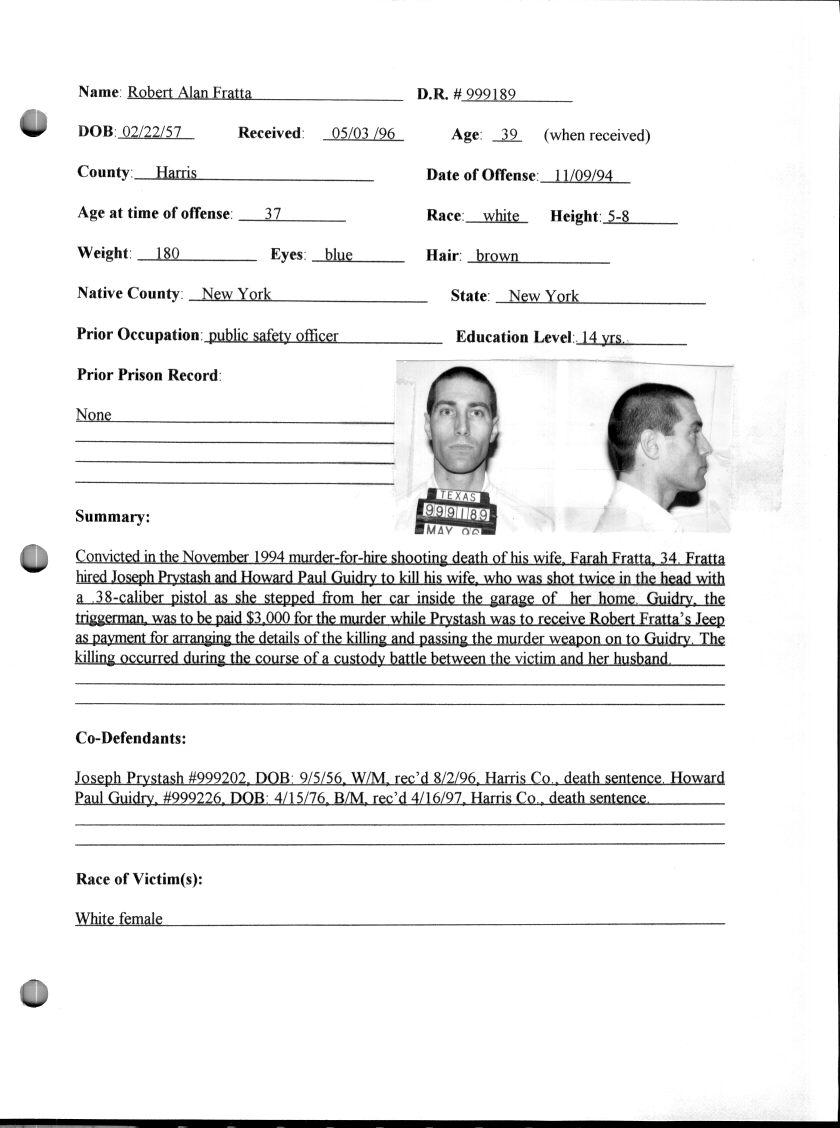
Robert Alan Fratta was convicted in 1996 of arranging his wife's murder. He was sentenced to death. Fratta had been in divorce proceedings with his wife. To gain custody of their children, his wife had made allegations of sexual perversion involving bathroom activities. The murder trial prosecutor used these allegations in an attempt to prejudice the jury. Fratta had no opportunity to confront the allegations, as he could not cross-examine the person who made them. Even in regard to living witnesses, Fratta's trial judge openly denied Fratta's Sixth Amendment right to confront his accusers. The judge permitted hearsay testimony from a police officer that an alleged co-conspirator had implicated himself and Fratta in the crime. Another witness testified to incriminating statements made by the alleged co-conspirator and a second alleged co-conspirator. Fratta's defense tried to call these alleged co-conspirators to refute the hearsay testimony, but the judge would not allow them to be called. (ODR) [11/07] | ||
Harris County, TX |
Robert Angleton |
Apr 16, 1997 |
|---|---|---|
|
Robert Angleton, also known as Bob, was a bookie who took bets
on sporting events. He was charged with murdering his 46-year-old
wife, Doris. Following the murder, Bob told police that he suspected
his brother Roger was the killer. Despite Roger's checkered past, Bob
had employed him in 1989. He fired him less than a year later. After being fired, Roger felt Bob owed him $200,000 and even tried to rob
him of it at gunpoint. Roger then threatened to put Bob out of
business, by reporting him to the IRS. Bob ignored him, but Roger
started making phone calls to customers, posing as an IRS agent. | ||
Lubbock County, TX |
Butch Martin |
Feb 25, 1998 |
|---|---|---|
|
Garland Leon Martin, also known as Butch, was convicted of the arson murders of his common law wife, Marcia Pool, her son, Michael Brady Stevens, age 3, and their joint daughter, Kristen Rhea Martin, age 1. The three died in a fire at the home they shared with Martin. The conviction was based in large part on a hypothesis that accelerants were used to start the fire. Some samples from fire remnants in the master bedroom reportedly tested positive for Norpar and deparaffinated kerosene. Norpar can be used as lamp oil and deparaffinated kerosene can be found in lighter fluid, but they are also common chemicals found in numerous household products. Experts dispute the supposition that these chemicals indicate the presence of accelerants and are petitioning to check the state's evidence that the alleged chemicals were even found. A defense investigator thought the fire started on the back porch rather than in the master bedroom near the back door. He criticized original investigators for discounting and then disposing of an electrical cord that was used to connect a refrigerator on the back porch to an outlet inside the house. He thought the fire marshal was looking for arson from the outset. (IP Arson) [7/07] | ||
Snohomish County, WA |
Jerry Jones, Jr. |
Dec 3, 1988 (Bothell) |
|---|---|---|
|
Jerry Jones, Jr. was convicted of murdering his wife, Lee. An intruder had entered his home and stabbed his wife at least 36 times. Jones intercepted the intruder before he ran off, and in trying to take away the intruder's knife, Jones cut tendons in his hand. Following the attack Jones behaved strangely, having gone into shock. He gave 911 dispatchers his old address where he lived for 5 years. The prosecution portrayed such behavior as suspicious. A neighborhood boy is an alternate suspect, who lied about his alibi and whose statements and later criminal record fully justify his being regarded as a suspect. Jones's daughters fully support their father's innocence in the murder of their mother. Jones's conviction was overturned twice, but he acted as his own attorney at his third trial and was reconvicted. (Justice: Denied) (48 Hours) [11/05] | ||
Snohomish County, WA |
Indle King |
Sept 22, 2000 |
|---|---|---|
|
Indle Gifford King, Jr. was convicted of murdering his
20-year-old mail order bride, Anastasia Solovieva, who was from Krygyzstan
in the former Soviet Union. King had met Anastasia through a magazine
that advertised foreign women to prospective American men. A boarder,
Daniel Larson, who rented a room in King's house, led police to her shallow
grave. At the time Larson had been arrested for sexually assaulting a
Ukrainian immigrant teenager. Larson said King had told him he
murdered Anastasia and showed him where he buried her body. Larson
later claimed he murdered King's wife under orders from King. King had
no criminal record while Larson had a history of violence, sexual assault,
and mental illness. In addition, Larson wrote a letter to a cult
leader, Christopher Turgeon, in which he stated that he killed Anastasia
alone. | ||
Brown County, WI |
John Maloney |
Feb 10, 1998 (Green Bay) |
|---|---|---|
|
John Maloney, a detective in the Green Bay PD, and an arson investigator, was convicted of strangling his estranged wife, Sandy, and setting her body on fire. Maloney was a suspect because of their impending divorce, ongoing child custody battle, and history of domestic disputes. Sandy was a heavy user of prescription pills and was very drunk at the time of her death. She apparently tried to hang herself shortly before her death, but the cord broke causing her to bruise her head on a coffee table. She then apparently started a fire by careless smoking or perhaps deliberately. The state maintained that Maloney hit her on the head, strangled her, and then set a fire that was staged to look like the result of careless smoking. Special prosecutor, Joe Paulus (DA of Winnebago County), withheld evidence. Initially the fire was labeled an accident but circular reasoning developed: “The fire guys decided it must be an arson because it was murder. The coroner decided it must be a murder because it was arson.” (TruthInJustice) (Article 2) (Article 3) (48 Hours) [11/05] | ||
Newfoundland, Canada |
Ronald Dalton |
Aug 16, 1988 (Gander) |
|---|---|---|
|
Ronald Dalton was convicted of the strangulation murder his wife Brenda. Dalton got a retrial because forensic evidence indicated that Brenda choked to death on dry cereal. At his retrial in 2000, Dalton was acquitted. (IB) (FJDB) [1/07] | ||
England (Stafford CC) |
Ryan James |
Jan 13, 1994 |
|---|---|---|
|
Ryan James was convicted of the murder of his 39-year-old wife, Sandra James. Sandra died from drinking a glass of orange juice that contained a fatal dose of immobilon, a horse tranquilizer. Ryan, a veterinarian, had access to the drug. He also been having an affair with another woman, Catherine Crooks. The lovers had left their spouses to live together, but the cost of running two homes drove Ryan back to his wife. Sandra's death would have allowed Ryan to start a new life with Catherine on the proceeds of a £180,000 life insurance policy. Besides these proceeds, £143,000 in debts were wiped out by Sandra's death. At trial, Ryan's defense argued that Sandra had committed suicide, but made it look like murder. However, the crown argued that it was murder made to look like a suicide. Ryan was sentenced to life in prison. His trial judge, Justice Anthony Hidden, told him he was “the most evil, selfish, and criminally callous man” he had ever sentenced. While in prison Ryan married Catherine, who never believed he killed his wife. While going through her new husband's belongings, Catherine found a handwritten note stuffed inside one of Ryan's professional journals. It was in Sandra's handwriting and said, “Ryan, I leave you absolutely nothing but this note – if you find it in time, Sam.” Sam was Sandra's pet name. Because the note indicated suicidal intent, Ryan's conviction was quashed in 1998 and he was released from prison. There was some additional evidence that Sandra was depressed. She had taken anti-depressants in the 1970s. At the time of Sandra's death there were puncture wounds in her foot. It was alleged that she had experimented with the immobilon drug by injecting it into her foot, then injecting herself with the antidote shortly thereafter. (Innocent) [10/08] | ||
China |
She Xianglin |
Convicted 1994 |
|---|---|---|
|
After having an argument with him, She Xianglin's wife, Zhang Zaiyu, went missing. Several weeks later police found the body of an unidentified woman in a local pond. Police interrogated Xianglin for 10 days, during which he was also tortured. Xianglin confessed to murdering his wife and was sentenced to death. His sentence was later reduced to 15 years imprisonment, after a higher court in the province (Hubei) overturned the verdict due to lack of evidence. Several of Xianglin's family members were also jailed for advocating his innocence or claiming that they saw Zhang alive after the authorities alleged she was dead. In March 2005, Zhang turned up alive and had merely run away from her marriage. She had remarried in a remote village in eastern Shandong province, unaware of the fate of her former husband. Xianglin was released. One of the officers who allegedly took part in Xianglin's torture hanged himself when authorities began an investigation into the incident. Xianglin and several family members were awarded 450,000 Yuan ($55,500) for wrongs committed against them. (FJDB) [12/06] | ||
Australia (WA) |
Rory Christie |
Nov 15, 2001 |
|---|---|---|
|
Rory Christie was convicted of the murder of his wife, Susan Christie. He was charged nearly a year after her disappearance. On retrial he was judicially acquitted because the evidence was insufficient to convict him. (IPWA) (Christie v. The Queen) (Regina v. Christie) | ||