Hearsay Testimony17 Cases |
Jefferson County, AL |
Louis Griffin |
Sept 24, 1992 |
|---|---|---|
|
Louis Griffin was sentenced to death for the gunshot murder of Christopher Lynn Davis. Following Davis's death, two men were indicted for the murder, Anthony Embry and Falanda Miles, based on eyewitness testimony and other evidence. Embry pleaded guilty to the crime and was sentenced to 20 years imprisonment while Miles was tried and acquitted of the charge. The Davis case was then closed. In April 1996, Griffin pleaded guilty in New York City to federal RICO law (racketeering) violations. Griffin was the “security man” for the 142nd Street Lynch Mob Crew. The Crew supplied illegal drugs to various parts of the country, including Alabama. As part of his plea Griffin entered into an allocation that he had participated in the Alabama murder of Davis. As a result of this allocation, Alabama authorities exonerated Embry of Davis's murder and initiated proceedings against Griffin. At trial, Griffin stated that he lied in federal court. However, he was barred from presenting any evidence that after the initial police investigation, the state believed that Embry and Miles committed the murder, or that Embry entered into a valid plea agreement admitting to the murder. This evidence was excluded because it was hearsay. On appeal in 2000, the Alabama Supreme Court reversed Griffin's conviction due to the excluded evidence. In 2001, Griffin was acquitted at retrial. (Griffin v. State) (Ex parte Griffin) (Alabama's Exonerated) [11/08] | ||
Palm Beach County, FL |
Gilbert Stokes |
Aug 15, 2000 (Belle Glade) |
|---|---|---|
|
Gilbert Stokes was convicted of murdering 18-year-old Jyron Seider during the robbery of a Belle Glade, Florida street dice game. Stokes was a member of the “Dogs Under Fire” gang while Seider was not. An appeals court overturned Stokes's conviction because the prosecutor repeatedly tried to create the impression that Stokes was motivated to kill Seider because he was a non-gang member. No evidence supported that assertion and it was clear that Stokes socialized with non-gang members. The court stated, “Here, the State lacked strong evidence and it is questionable, under the facts of this case, whether the jury would have found Stokes guilty without hearing evidence of his DUF membership.” The appeals court also overturned the conviction because the trial judge improperly allowed a detective to give hearsay testimony that alleged witnesses who did not come to court to testify had implicated Stokes in the murder. DNA evidence and two eyewitnesses linked the state's star witness, Leon Harrell, to the murder. The two witnesses said that Stokes was not involved. Police originally arrested Harrell for the murder, but they were unable to make a case against him before his constitutional right to a speedy trial ran out. At Stokes's second trial in 2006, Harrell refused to testify against Stokes unless prosecutors promised him leniency on unrelated drug charges. Prosecutors then offered Stokes a plea deal which he accepted on advice of his attorney. Though he maintained his innocence, Stokes pled guilty to manslaughter and aggravated assault in exchange for a 12-year sentence. He had already served five years and could be released before he served another five. According to Stokes's attorney, it is “better to be 32 and walking the streets than 65 and making license plates.” (JD) (Sun Sentinel) [2/07] | ||
Whitley County, KY |
Larry Osborne |
Dec 14, 1997 |
|---|---|---|
|
Larry Osborne was convicted of murdering Sam Davenport, 82, and his wife Lillian, 76. He was sentenced to death. The victims were hit over the head and their house was set on fire. They died of smoke inhalation. Osborne, 17, and his friend, Joe Reid, 15, said they heard breaking glass from the Davenport home when they passed it while riding a motorbike on the night of the murders. Osborne phoned his mother, who in turn phoned the police. When the police arrived at the scene, the house was in flames. After repeated interrogations, police got 15-year-old Reid to state that Osborne committed the murders while he waited outside. In a police videotape of Reid's statements, Reid is seen asking “Is this going to get me out of all this stuff?” Reid also stated that after Osborne set fire to the house, he left it through the back door. However the back door had a dead bolt lock, with a double key. It is not believed that anyone one went through it that night. Before Reid could testify at Osborne's trial, he drowned while swimming in Jellico, Tennessee. His death was ruled accidental. At Osborne's trial, the prosecutor read Reid's statement. The defense objected, but the judge overruled the objection. On appeal, the Kentucky Supreme Court overturned Osborne's conviction. Reid's testimony was ruled inadmissible because a dead witness cannot be cross-examined. Osborne was acquitted at retrial after spending three years on death row. (Louisville CJ) (TWM) (JD) | ||
Suffolk County, MA |
Christian Amado |
Feb 4, 1980 |
|---|---|---|
|
Christian Amado was convicted of the shooting murder of 28-year-old George Sneed. The conviction was due to testimony that an eyewitness, Frederick Johnson, had selected a photo of Amado, had identified the assailant as “Bugsy,” and had associated the name “Bugsy” with Amado. When called to testify, Johnson readily answered a series of question on the sequence of events leading up to the murder. However, his testimony became evasive and confusing when asked about his previous identification of Amado. The prosecutor had to repeatedly refresh Johnson's “recollection of events,” by showing him what purported to be a transcript of statements he had given to police. Johnson appeared to deny identifying Amado and claimed that he had selected Amado's picture because it “looked familiar.” The prosecutor never asked Johnson if Amado was the killer. On cross-examination by defense counsel, Johnson denied that Amado was the killer or was present at the scene of the killing. Three detectives were called as witnesses and testified to Johnson's previous identification of Amado. According to Amado's attorney, “The eyewitness in the case identified a photo that looked like Amado, but when he came into court and saw my client he said he knew Amado wasn't the killer.” In 1982, an appeals court ruled that the trial court erred in presenting contrary testimony to prove identification. It reversed Amado's conviction and directed a verdict of acquittal. (CIPM) (Com v. Amado) [4/08] | ||
Genesee County, MI |
Sharee Miller |
Nov 9, 1999 (Flint) |
|---|---|---|
|
While married to a different man, Sharee Miller had an online
romance with an ex-police detective, Jerry Cassaday, from Reno, Nevada, whom
she met on the Internet. Sharee had told him numerous lies such as being
wealthy. She had also traveled to Reno five times and had a physical
affair. In her emails, she said she was married to a terminally ill
husband, Jeff, who would die soon and that they could be together soon. Then she told him her husband died, but she had to marry his brother, Bruce,
because of family pressure. She twice told Jerry she was pregnant with his
child. | ||
Wilkinson County, MS |
Leon Chambers |
June 14, 1969 (Woodville) |
|---|---|---|
|
Leon Chambers was convicted of the murder of Sonny Liberty, a
police officer. Two Woodville police officers, James Forman and Aaron
“Sonny” Liberty, tried to arrest a local youth named C. C. Jackson at Hayes'
Café, a bar and pool hall on First West St. However, a crowd of 50 to
60 people gathered who frustrated their arrest attempt. Forman radioed
for backup and Liberty removed his riot gun, a 12-gauge sawed-off shotgun,
from his patrol car. | ||
Jefferson County, MO |
Hess & Craig |
Jan 7, 1929 |
|---|---|---|
|
Walter Hess and Alvin Craig were convicted of the murder of Virgil Romine, an attendant at a restaurant associated with the Artesian Park filling station near St. Louis. After being shot and prior to his death, Romine mistakenly claimed that his assailants were the same fellows who put slugs in a restaurant slot machine some weeks before. Upon being visited by the police, Hess and Craig readily admitted they were the ones who had slugged the restaurant's slot machine. However, they denied any knowledge of the murder. Attempts at trial to ban hearsay testimony regarding what Romine said about his assailants were denied on the grounds that Romine gave a dying declaration. A year after the defendants' convictions the real perpetrators were identified and convicted. Missouri Governor Caulfield then pardoned Hess and Craig on the grounds that they were innocent. (CTI) [6/08] | ||
Douglas County, NE |
Jeremy Sheets |
Sept 23, 1992 |
|---|---|---|
|
Jeremy C. Sheets was convicted in 1997 of the murder of 17-year-old Kenyatta Bush. His alleged accomplice, Adam Barnett, confessed to the crime and implicated Sheets in exchange for a plea deal. Barnett later recanted his confession and committed suicide prior to Sheets's trial. Barnett's taped confession was the key evidence used against Sheets at trial. In 2000, the Nebraska Supreme Court overturned the conviction because it deemed Barnett's confession “highly suspect,” “inherently unreliable,” and hence inadmissible without the opportunity for Sheets to cross-examine Barnett. Prosecutors dropped charges against Sheets after the U.S. Supreme Court declined to hear their appeal. (State v. Sheets) [9/05] | ||
Eddy County, NM |
Ralph Rodney Earnest |
Feb 12, 1982 |
|---|---|---|
|
Ralph Rodney Earnest was convicted of murdering 31-year-old David Eastman, an oil field worker who was killed near Carlsbad, NM. Eastman's body was found on Feb. 12, 1982 in a ditch beside N.M. 31. At Earnest's trial, his two co-defendants, Perry Conner and Phillip Boeglin, were called to testify. Conner testified that while he and Boeglin committed the crime, Earnest was not involved. Boeglin refused to testify, even though he was given immunity from the use of his testimony and was held in contempt of court for his refusal to testify. The prosecution then introduced into evidence a taped recoding and a transcript of a unsworn statement made by Boeglin to police on the day of his arrest. In the statement Boeglin admitted that he attempted to cut Eastman's throat, but he implicated both Conner and Earnest, stating Earnest shot Eastman in the head. In 2007, the New Mexico Supreme Court overturned Earnest's conviction because he was denied the opportunity to cross-examine Boeglin regarding the taped statement and was thereby deprived of his Sixth Amendment right to confront an accuser. The prosecution had to drop charges against Eastman because Boeglin again refused to testify. (AJ#1) (AJ#2) (Appeals) [2/10] | ||
Grady County, OK |
Richard Jones |
Jan 23, 1983 |
|---|---|---|
|
Richard Neal Jones was convicted of murdering Charles Keene. Keene was abducted from his home in Amber and murdered near Chickasha. Jones maintained that he was passed out while his three co-defendants beat up Keene, shot him, and threw his weighted body into the Washita River. Keene had apparently been abusing his ex-wife who was the sister of two of the defendants. The trial court allowed into evidence incriminating post-offense statements by Jones's co-defendants, none of whom testified at Jones' trial. An appeals court granted him a retrial, holding that the jury was prejudiced by the admission of hearsay testimony and inflammatory photographs. It also held that the case was not one in which Jones's guilt was “overwhelming” and that Jones's involvement was disputed by the evidence. Jones was acquitted on retrial in 1988. (Archives) [10/05] | ||
Seminole County, OK |
Paul Goodwin |
July 4, 1936 |
|---|---|---|
|
Paul Goodwin was convicted of the murder of Officer Christopher C. Whitson of the Seminole Police Department. Another man, Horace Lindsay, gave a statement in which he confessed to shooting Whitson. Lindsay also led police to the location where he had hidden Whitson's gun. Some time later Lindsay gave a second statement in which he implicated Goodwin as the shooter, but he refused to testify against Goodwin at his trial. At Goodwin's trial, Lindsay's second statement was read into evidence before the jury by the Chief of Police of Seminole County. Goodwin was permitted no opportunity to cross-examine Lindsay, nor was he permitted to introduce Lindsay's earlier statement which contradicted the presented statement. Although paroled in 1961, Goodwin was reincarcerated in 1962 on a parole violation. In 1969 Goodwin was released from prison after the 10th Circuit Federal Court ruled that he was denied due process. (Appeals) (Seminole PD) (ISI) [10/09] | ||
Dauphin County, PA |
Jay Smith |
June 24, 1979 |
|---|---|---|
|
Dr. Jay Charles Smith was sentenced to death in 1985 for the
1979 murders of Susan Gallagher Reinert and her two children. Smith was the
principal of Upper Merion Senior High School (in Montgomery County) from
1966 until 1978 and Reinert was a teacher there. He had a PhD and was also
an Army Reserve colonel. In 1978, he was promoted from his principal's
position to work directly for the Upper Merion Area School District. | ||
Sullivan County, TN |
Jeffrey Dicks |
Feb 15, 1978 (Kingsport) |
|---|---|---|
|
Jeffrey Stewart Dicks and another man, Donald Wayne Strouth, were convicted of the capital felony murder of James Keegan. Keegan was killed during the robbery of a Kingsport clothing store. At Strouth's trial, the state presented hearsay evidence that
Strouth had committed the murder. Different people related that Strouth had
said to them that he hit the victim in the head with a rock, that he had to
hurt the victim, and that he had to slit his throat. The state vouchsafed
this evidence as trustworthy as it was inculpatory of Strouth. However, at
Dicks's trial the same evidence was deemed untrustworthy and prohibited, as
it was exculpatory of Dicks. One would think the reverse situation might
apply, as the evidence might be trustworthy enough to prove reasonable
doubt, but not absolute guilt. Other witnesses offering evidence of
Dick's innocence were also prohibited from testifying. Dicks was prevented
from presenting a full defense as allowed by the U.S. Supreme Court in
Chambers v. Mississippi. | ||
Harris County, TX |
Robert Fratta |
Nov 9, 1994 |
|---|---|---|
|
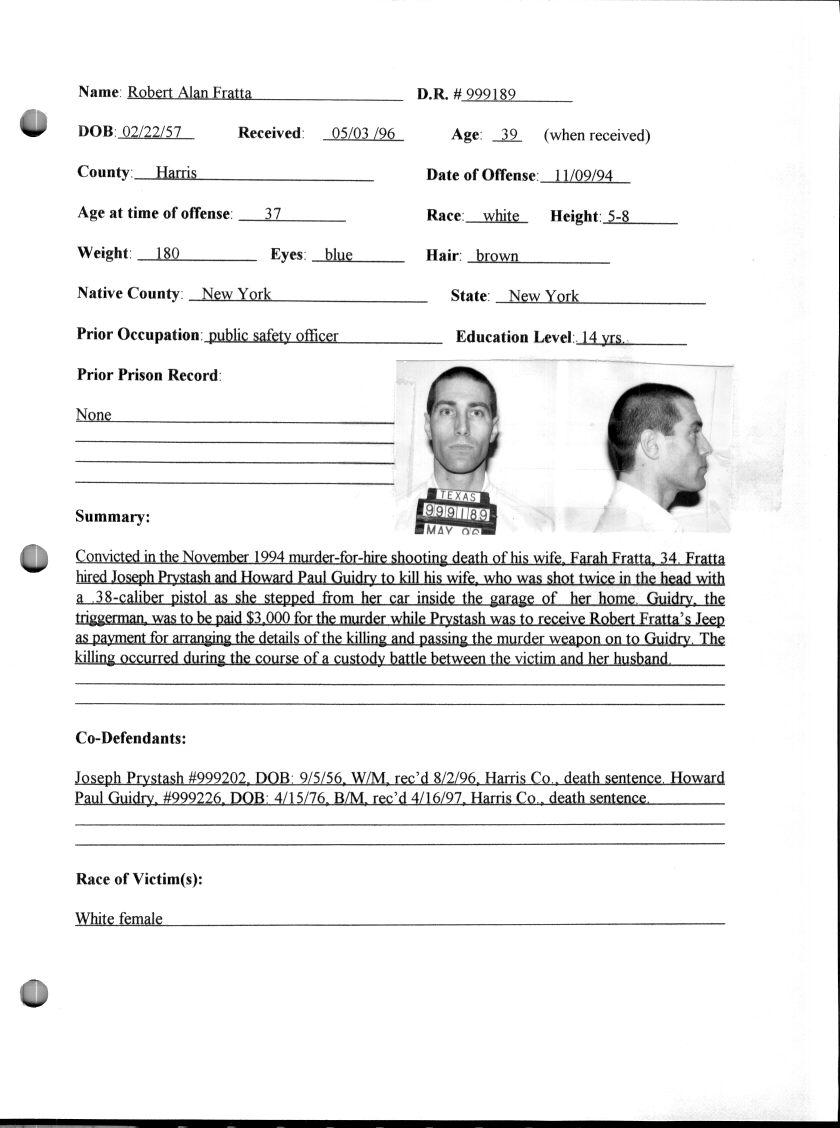
Robert Alan Fratta was convicted in 1996 of arranging his wife's murder. He was sentenced to death. Fratta had been in divorce proceedings with his wife. To gain custody of their children, his wife had made allegations of sexual perversion involving bathroom activities. The murder trial prosecutor used these allegations in an attempt to prejudice the jury. Fratta had no opportunity to confront the allegations, as he could not cross-examine the person who made them. Even in regard to living witnesses, Fratta's trial judge openly denied Fratta's Sixth Amendment right to confront his accusers. The judge permitted hearsay testimony from a police officer that an alleged co-conspirator had implicated himself and Fratta in the crime. Another witness testified to incriminating statements made by the alleged co-conspirator and a second alleged co-conspirator. Fratta's defense tried to call these alleged co-conspirators to refute the hearsay testimony, but the judge would not allow them to be called. (ODR) [11/07] | ||
Harris County, TX |
Robert Angleton |
Apr 16, 1997 |
|---|---|---|
|
Robert Angleton, also known as Bob, was a bookie who took bets
on sporting events. He was charged with murdering his 46-year-old
wife, Doris. Following the murder, Bob told police that he suspected
his brother Roger was the killer. Despite Roger's checkered past, Bob
had employed him in 1989. He fired him less than a year later. After being fired, Roger felt Bob owed him $200,000 and even tried to rob
him of it at gunpoint. Roger then threatened to put Bob out of
business, by reporting him to the IRS. Bob ignored him, but Roger
started making phone calls to customers, posing as an IRS agent. | ||
McLennan County, TX |
Muneer Deeb |
July 14, 1982 (Waco) |
|---|---|---|
|
Muneer Deeb, a convenience store owner, had allegedly hired three men to kill a female employee on whom he had a $20,000 accident policy. However, Deeb had such policies on all his employees as a hedge against worker compensation claims. The prosecution alleged that the three men then mistakenly killed a woman who was not an employee. The murdered woman did not seem to be the victim of a contractual killing as she was raped and tortured, as were two of her friends. None of his three alleged co-conspirators testified against Deeb even though they were charged with capital murder like Deeb and were in a position to negotiate for a reduced sentence. One trial witness testified that Deeb had acknowledged he would receive insurance money if one of his employees ever was murdered. Deeb was convicted and sentenced to death. Deeb's conviction was overturned because the judge allowed a jailhouse informant to give hearsay testimony about statements allegedly made by one of Deeb's alleged co-conspirators. This informant described a murder for hire scheme in detail. Deeb was acquitted at retrial in 1993. (CWC) | ||
Runnels County, TX |
Luis Ramirez |
Apr 8, 1998 |
|---|---|---|
|
Luis Ramirez was executed for the murder of Nemicio Nandin who was reportedly dating Ramirez's ex-wife. Ramirez's conviction was based on the testimony of police informant Tim Hoogstra, a self-admitted “daily drug abuser,” who was paid $500 for his testimony. Hoogstra was also granted leniency on a shoplifting charge and other pending charges. In addition he was promised “Crime Stopper” money upon Ramirez's conviction. Hoogstra gave testimony that when he was getting high with another man named Edward Bell, Bell told him Ramirez paid him $1000 to kill Nandin. Bell was never called to testify nor had he ever given a statement to corroborate Hoogstra’s testimony. Ramirez was denied his Sixth Amendment right to dispute Hoogstra's testimony by cross-examining Bell. Ramirez told his court-appointed attorney, Gonzalo Rios, to call an alibi witness, Patricia Raby, but Rios refused to even talk to her. Ramirez thought Rios was prejudiced against him because he found out later that Rios's brother and cousin had been murdered two decades before and another cousin shot. Ramirez said he never met Nandin, Hoogstra, or Bell, and has no knowledge of whether or not Nandin dated his ex-wife. Ramirez was executed by lethal injection on Oct. 20, 2005. (IIPPI) (Statement of LR) | ||