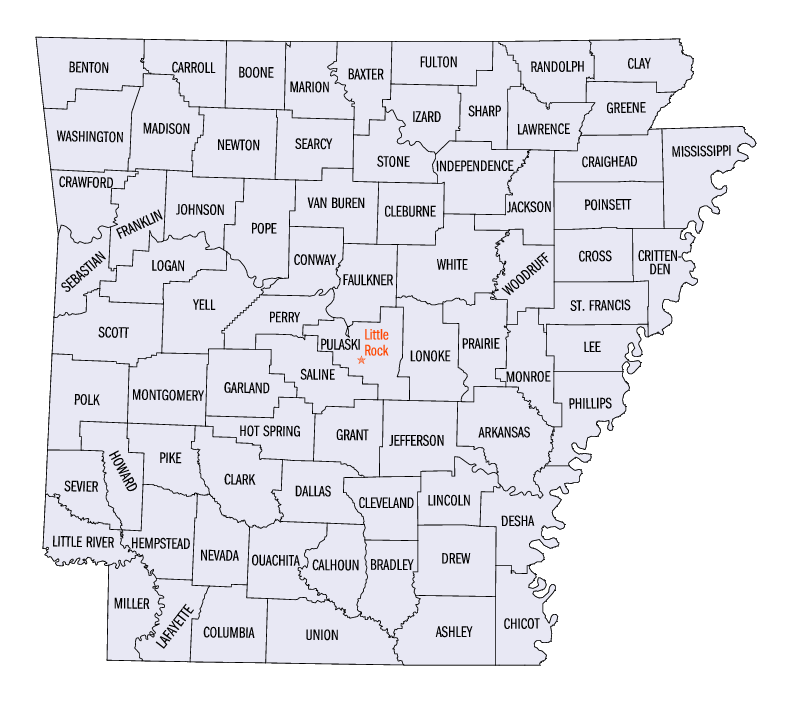
Arkansas
|
Crittenden County, AR |
West Memphis Three |
May 5, 1993 (W. Memphis) |
|---|---|---|
|
Jesse Misskelley Jr., Damien Echols, and Jason Baldwin were accused as teenagers of killing three eight-year-old boys. Misskelley, who is mentally handicapped, gave an error filled confession after 12 hours of police questioning, which he soon recanted. Misskelley confessed that he witnessed the murders taking place around noon when, in fact, the victims were all in school. The victims did not disappear until after approximately 5:30 p.m. Numerous alibi witnesses testified that at the time the three victims disappeared and for the next five hours (during which the murders probably occurred), Misskelley was at a wrestling competition in a town forty miles away from the crime scene. With no physical evidence, murder weapon, motive, or connection to the victims, the prosecution resorted to presenting black hair and clothing, heavy metal T-shirts, and Stephen King novels as proof that the victims were sacrificed in a satanic cult ritual. The defendants were convicted and sentenced to life plus 40, death, and life without parole, respectively. A book about the case was written entitled Devil's Knot: The True Story of the West Memphis Three by Mara Leveritt. (www.wm3.org) [9/05] | ||
Desha County, AR |
Tony Thrash |
June 6, 1980 (Dumas) |
|---|---|---|
|
Anthony Thrash was convicted of the murder of Tommy Gill. (Justice: Denied) | ||
Faulkner County, AR |
Marvin Earl Goodsell |
2006 |
|---|---|---|
|
“Marvin Earl Goodsell was wrongly convicted of four counts of sexually assaulting two girls [his stepdaughters, ages 14 and 17]. Goodsell supposedly confessed, but at his trial he denied committing the crimes and the girls denied anything inappropriate occurred between them and Goodsell. Arkansas' law requires independent corroboration that a crime occurred apart from an out of court ‘confession.’ The judge refused to direct a verdict of acquittal after the state rested its case. On December 17, 2008 the Arkansas Court of Appeals unanimously vacated Goodsell's convictions and ordered his release on the grounds that there was insufficient evidence that a crime had occurred.” – FJDB (Goodsell v. State) (Log Cabin Democrat) | ||
Garland County, AR |
Ayliff Draper |
Mar 1935 |
|---|---|---|
|
Ayliff Draper was convicted of the murder of Tom Menser. (In Spite of Innocence) | ||
Greene County, AR |
Denver Mitchell |
Aug 18, 1990 (Paragould) |
|---|---|---|
|
Denver Wayne Mitchell, Jr. was convicted of murder for fending
off a sexual solicitation. In Aug. 1990, while working in Amarillo, TX,
Mitchell received a letter from his father asking him to come home to West
Frankfort, IL. On Aug. 17, Mitchell hitched a ride near Amarillo in a truck
driven by a 74-year-old man named Willard. The two made it to Paragould, AR
where they stopped for the night. Willard told Mitchell he could spend the
night in the truck and that he, Willard, would take him to Highway 55 in the
morning. The two also stopped at a bar, drank alcohol, and purchased some
beer to go. Willard then drove the truck to an area where they could camp
out. | ||
Marion County, AR |
Charles Hudspeth |
1887 |
|---|---|---|
|
Charles Hudspeth was convicted of murder and hanged while his alleged victim was still alive. Hudspeth became romantically involved with Rebecca Watkins, and when the two were questioned on the disappearance of Rebecca's husband, George Watkins, Rebecca told authorities Hudspeth had killed him. Hudspeth was granted a retrial because testimony regarding Rebecca's alleged lack of good character was improperly barred. Hudspeth was convicted again and hanged on December 30, 1892. In June 1893, Hudspeth's lawyer located George Watkins alive and living in Kansas. (CWC) [7/05] | ||
Phillips County, AR |
Elaine 51 |
Sept 30, 1919 |
|---|---|---|
|
On Sept. 30, 1919, black sharecroppers held a meeting at a church in Hoop Spur, outside Elaine, Arkansas. The purpose was to obtain better payments for cotton crops in the face of patently unfair practices of white landowners. After two deputized white men and a black trustee arrived, shots rang out. One of the white men was killed and the other was wounded. Who fired first is not clear. In any event, a posse of hundreds of white men was dispatched to put down an alleged black rebellion. Five whites and between 100 and 200 blacks were killed in the days that followed. Following the “rebellion,” 12 blacks were convicted of first-degree murder and sentenced to death. Ten were convicted of second-degree murder and sentenced to 21 years of imprisonment. Another 29 were convicted of second-degree-murder and sentenced to 5 years of imprisonment. None of the defendants were executed and in 1925 the state governor granted indefinite furloughs to those that remained imprisoned. (PCR) (EA) (Moore v. Dempsey) (Blood in their Eyes) (On the Laps of Gods) [1/10] | ||
Pulaski County, AR |
James Dean Walker |
Apr 16, 1963 |
|---|---|---|
|
James Dean Walker was convicted of murdering Police Officer
Jerrell Vaughn of North Little Rock. Walker and a companion, Russell
Kumpe, were at a Little Rock nightclub with two women, one of whom was Linda
Ford. Following an altercation at the club in which another patron was
shot, Kumpe, Walker, and Ford left in Kumpe's Oldsmobile. Kumpe drove,
while Walker sat in the passenger seat, with Ford sitting in the center. Police Officer Gene Barentine pursued and stopped the car and parked his
vehicle behind it. Officer Vaughan arrived on the scene almost
immediately thereafter, as did two cabdrivers. | ||
Pulaski County, AR |
Barry Lee Fairchild |
Feb 26, 1983 |
|---|---|---|
|
Barry Lee Fairchild was convicted of the kidnapping, rape, and
murder of a 22-year-old Marjorie “Greta” Mason. Mason was a white Air
Force nurse and a former homecoming queen. Six days after the murder
and after the media had reported many details of the crime, the police
received a tip from an unnamed informant, a man described in police files as
inaccurate about half the time, with a tendency to exaggerate. He
named Barry Lee Fairchild as one of the culprits. | ||
Sebastian County, AR |
Wilburn Henderson |
Nov 26, 1980 (Ft. Smith) |
|---|---|---|
|
Wilburn L. Henderson was sentenced to death for the murder of
Willa Dean O'Neal. The murder occurred during an alleged robbery of $41 at
a Ft. Smith furniture store that the victim owned with her husband. Police
found a yellow piece of paper in the store containing two phone numbers that
a real estate agent had given to Henderson. Henderson conceded the paper
was his and that he must have dropped it when he was in the store days
before the murder. Under police interrogation Henderson gave a statement
that he had just happened to have been in the store when another man
committed the crime. He later recanted the statement saying he only made it
because he feared police would harm him. According to the prosecution,
Henderson had obtained a gun from a pawnshop and then pawned it back just
after the murder. However, ballistics tests on the gun were inconclusive
that it was the murder weapon. | ||
Washington County, AR |
Isaac Marta |
1996 (Fayetteville) |
|---|---|---|
|
Isaac Marta was convicted of murder due to testimony from the actual killer. (Justice: Denied) | ||