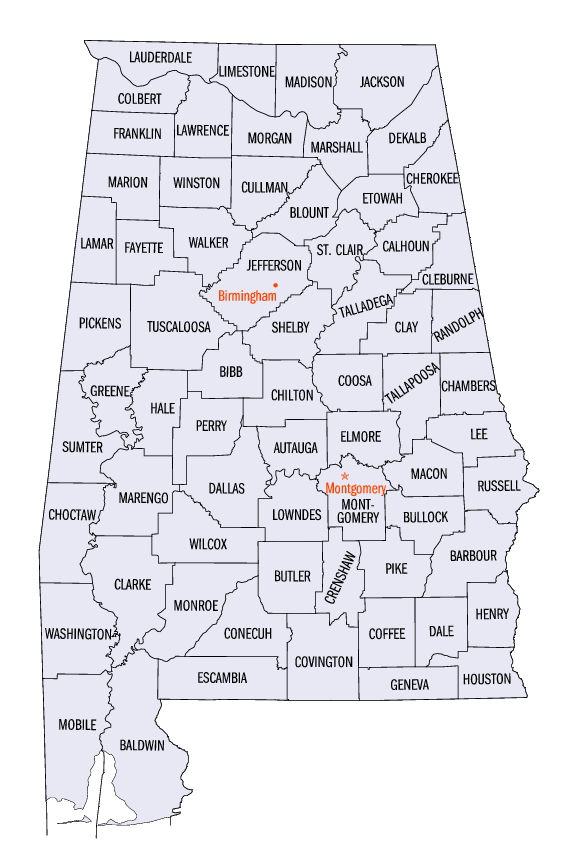
Alabama

28 Cases

Main Menu


County:   Blount   Calhoun   Choctaw   Coffee   Colbert   Escambia   Fayette   Jackson   Jefferson   Lowndes   Madison   Marshall   Mobile   Monroe   Montgomery   Morgan   Shelby   Tallapoosa   Unknown


Location

Defendant(s)

Date of Alleged Crime


Blount County, AL Bill Wilson Late 1908

In 1908, Bill Wilson's wife, Jenny, divorced and left him.  She took their 19-month-old child with her.  In 1912, the skeletal remains of an adult and child were discovered by the Warrior River.  As news of the discovery spread, many area residents, presuming the remains to be ancient, visited the site in the hope of finding Indian relics.

When no relics were found, a farm worker named Jim House began speculating that the remains were not Indian but those of Jenny Wilson and her child, both of whom had disappeared shortly after Jenny’s divorce.  House also belatedly asserted that, following the divorce, he had seen Jenny go into her former in-laws’ home carrying a basket. The next day, House said, he noticed footprints leading toward the river and found what he described as a “child’s cloth” and blood on a rock.  After hearing House’s tale, the county solicitor charged Bill Wilson with murder.

At trial the prosecution presented this evidence, along with witnesses who alleged that Bill had made incriminating statements.  One claimed that Bill had vowed to kill Jenny if he ever saw her again.  The prosecution’s medical expert acknowledged that the remains appeared too ancient to be that of Jenny and her child, though he left open the possibility that they were.  He acknowledged the skull of the child had second teeth, which usually do not develop before age four.

The defense presented six witnesses, including Jenny’s sister, who testified that they saw Jenny at various times several months after the prosecution contended she was dead.  Four of Bill’s relatives, and Bill himself, denied House’s contention that Jenny had come to Bill’s parents’ home after the divorce.  The defense medical expert testified that the teeth in the adult skull were those of an elderly person and that a 19-month-old child would not have second teeth.

Despite this strong defense, Bill Wilson was convicted and the trial judge, Judge Blackwood, sentenced him to life in prison on Dec. 18, 1915.  After the trial, a curator from the Smithsonian Institution in Washington, DC examined the bones and declared them to be very old skeletal parts of four or more persons.  Judge Blackwood concluded that justice had miscarried, but he no longer had jurisdiction of the case.  He asked the governor to grant clemency to Bill, so that he could be released.  Before the governor took action, Bill’s appellate lawyer located Jenny and her child, then 11, living in Vincennes, Indiana.  She returned to Blount County on July 8, 1918, and the same day, after authorities confirmed her identity, the governor granted Bill a pardon.  (NL)  [1/07]


Calhoun County, AL Roosevelt Collins 1936

Collins, a black man, was accused of rape by Mae Hill, his married white girlfriend, after her brother-in-law discovered their relationship.  At trial, the alleged victim's husband fired a shot at Collins after he testified that she had consented to his advances.  Collins was convicted after four minutes of jury deliberation.  Several jurors and the judge later admitted that they thought the woman had consented to sex with Collins, but that he deserved the death sentence for "messin' around" with a white woman.  Collins was executed in the electric chair at Kilby prison  in June 1937.  (Presumed Guilty) (ISI)  [7/05]


Choctaw County, AL Choctaw Three 1999

In Feb. 1999, Victoria Bell Banks was in the county jail and pretended to be pregnant as a ploy to get released.  She had two doctors check on her, the second of which claimed to have heard a fetal heartbeat.  Victoria was released on bond in May 1999, after she threatened to sue the jail for failing to provide prenatal care.  In August, the sheriff, Donald Lolly, stopped Victoria and questioned her about the baby that was due in June.  After Victoria told him she miscarried, the sheriff took her to the second doctor who examined her before, and he could find no evidence she had ever been pregnant.  The sheriff then had officials with the Alabama Bureau of Investigation question her to find out where was the missing baby.  Victoria could not have been pregnant because she had had her tubes tied in 1995.

After being questioned for extended periods of time, Victoria, her husband Medell Banks Jr., and her sister, Dianne Bell Tucker all reportedly confessed to participating in the killing of the non-existent child.  They were charged with capital murder in Sept. 1999.  Rather than face the electric chair, Victoria pleaded guilty to manslaughter after her trial had begun in Nov 2000, and the other two did likewise six months later as their trial dates approached.  All were sentenced to 15 years in prison.  A nationally known fertility doctor examined Victoria and concluded she was sterile.  The prosecutor filed perjury charges against Victoria for telling a judge she had not been pregnant.  The charges were dismissed in Jan. 2003 when Victoria signed a statement that said, "I, Victoria Banks, hereby state that I lied when I said I didn't have a baby.  I am sorry."  Medell Banks faced retrial on capital murder charges in Jan 2003, but all charges were dropped after pretrial hearings established that Medell never admitted to killing a baby.  (JusticeDenied) (ForeJustice)  [11/05]


Coffee County, AL George W. White Feb 27, 1985 (Enterprise)
Both George and his wife Charlene were shot multiple times by a masked gunman.  George survived but Charlene died.  Sixteen months later George was charged with the murder of his wife.  Following a trial that was later characterized as a mockery and a sham, George was convicted and sentenced to life in prison.  In 1989, the conviction was overturned after George spent over 27 months in prison.  In 1992, the charge was dismissed after proof of George's innocence surfaced.  George is a co-founder of Citizens United for Alternatives to the Death Penalty and served on the board of Murder Victims Families for Reconciliation from 1994 to 1998.  (JourneyOfHope) (JD01)  [6/05]


Colbert County, AL

Thomas Arthur

Feb 1, 1981 (Muscle Shoals)

Thomas Douglas Arthur was sentenced to death for the murder of Troy Wicker, Jr., the husband of his girlfriend, Judy Wicker.  Judy and her sister, Theresa Rowland, were found at the scene of the crime.  Judy said a black man raped her and then fatally shot her husband.  Both sisters had blood on their clothes, but neither was tested to see if they fired the gun that killed the victim.  The gun used in the murder was never found.

Judy was charged with the murder because she had $90,000 of life insurance on her husband.  She testified at Arthur’s first and second trials that he had nothing to do with the murder.  However, after she served 10 years of imprisonment, she changed her testimony at Arthur’s third trial in exchange for being released from prison.  She said she was assisted in the crime by Arthur, Rowland, and Rowland’s boyfriend, Thereon McKinney.  She named Arthur as the person who pulled the trigger.  Neither Rowland nor McKinney was ever charged in the murder.  Rowland had previously hired the victim to burn down her trailer, so that she could collect insurance on it.  When Rowland failed to pay the victim his promised fee, he had threatened to have her arrested for arson.  Rowland also had her own key to the Wicker residence, where the murder occurred.  The prosecutor at Arthur’s third trial had served as Wicker’s defense attorney during her previously unsuccessful parole hearing.

No physical evidence connects Arthur to the scene of the crime.  He never had an investigator to check out basics regarding his alibi, like phone records and receipts.  Initially, two eyewitnesses signed affidavits placing Arthur in Decatur, AL, 75 miles away, at the time of the crime.  However, after being visited by the state of Alabama, these witnesses changed their testimony.  Later, one witness changed back to his original testimony, while the other witness has made statements that he is frightened of losing his business and "other" things.

Alabama will not allow Arthur to perform DNA testing on the semen evidence collected from Judy or on the blood and hair evidence found at the crime scene.  Arthur was scheduled to be executed on July 31, 2008, but it was stayed the day before after another man, Bobby Ray Gilbert, confessed to the crime.  (AI) (www.thomasarthurfightforlife.com)  [8/07]


Escambia County, AL Dewayne Cunningham Aug 20, 1995 (Flomaton)
Dewayne Scott Cunningham was convicted of rape after the victim identified him while he was handcuffed in the back of a police car.  Such a “show-up” identification is considered less reliable than lineup or photo lineup identifications.  The victim gave a written statement that her assailant as "not tall," only a couple of inches taller than her own 5’4” frame.  Cunningham is 6’ tall.  The victim also estimated his age at between 30 and 40 years old; Cunningham was 26 at the time.  There is also a question of motive.  The victim was female, but Cunningham is an apparent homosexual.  He worked as a male prostitute and reports that he has a “husband” in prison.  Alabama does not allow for post-conviction DNA tests of crime evidence, and as of 2006, Cunningham has filed a federal lawsuit in Mobile to gain access to the evidence for such tests.  (Press-Register)  [3/07]


Fayette County, AL Berry Innocents Convicted 1933 (Berry)

Glenn Davis, Bill Hathaway, and Herschel McCarn were convicted of robbing the Bank of Berry of $5237.75.  The convictions were due to the three men's remarkable resemblance to the actual robbers.  All three were pardoned in 1940.  [7/05]


Jackson County, AL Scottsboro Boys Mar 25, 1931 (Scottsboro)

Nine black juveniles were falsely charged in 1931 with raping a white girl.  Eight were convicted and sentenced to death.  The ninth defendant got a mistrial because the prosecutor only wanted a life sentence and some jurors held out for death.  Although one of the boys was later shot to death by a sheriff, none were officially executed, and four were released in 1937.  One violated parole by going to Michigan, but in 1950 the Michigan Governor refused to extradite him.  Another violated parole in 1946, became a fugitive until 1976, when he was given a full pardon by Gov. George Wallace.  The longest survivor died in 1989.  Several books were written about this case.  (Famous Trials)  [3/05]


Jefferson County, AL Freddie Lee Gaines 1972 (Birmingham)

Gaines was charged with killing Johnnie Lee Swanson and Mary Ann Wright at an illegal shot house in Birmingham.  Gaines was acquitted of killing Wright, but convicted of killing Swanson.  Gaines was sentenced to 30 years in prison, but was released in 1985.  In 1990, a Florida man confessed to the killings, and in 1996 the Alabama Legislature passed a bill to pay Gaines $1 million over 10 years as compensation for the time he wrongly served in prison.  Gaines was the second person to be compensated by the state.  The state had previously compensated one of the Scottsboro Boys defendants who was convicted in 1931.  [3/06]


Jefferson County, AL James Bo Cochran Nov 4, 1976

Cochran was convicted of murdering Stephen Ganey, the assistant manager of a grocery store.  The conviction occurred at Cochran's second trial, as his first trial ended in a mistrial.  This conviction was overturned and Cochran was again convicted at his third trial in 1982.  This second conviction was also overturned and Cochran was tried for a fourth time in 1997.  At the fourth trial, defense counsel pointed out to jurors that there were no eyewitnesses to the murder and that it would have been impossible for Cochran to move the victim's body under a trailer in a nearby mobile home park while being chased by police.  The jury at the fourth trial acquitted Cochran of all charges.  Cochran’s case is featured in the documentary film “Death in Dixie.”  (DRE) (DPIC)  [3/06]


Jefferson County, AL Ronnie & Dale Mahan Nov 30, 1983
The Mahan brothers were convicted of kidnapping and raping 18-year-old Pamela Pope.  Pope identified the brothers from a photo lineup.  She said she got a look at the perpetrators when they lifted their masks.  The Mahans were sentenced to life and 35 years respectively.  Ronnie and Dale spent more than 12 years in prison before DNA tests exonerated them in 1998.  (IP054) (IP053) (Chicago Tribune)  [12/05]


Jefferson County, AL Taurus Carroll Apr 9, 1995
Carroll was convicted of the murdering Betty Long during a robbery of the laundromat that she operated in Birmingham.  Carroll, a juvenile at the time of the crime, was convicted due to a coerced false confession.  (TC)  [3/05]


Jefferson County, AL Wesley Quick 1995 (Turkey Creek)

Quick was convicted of murdering teenagers John Hughes and Nathan King, who were gunned down at Turkey Creek.  His first trial ended in a mistrial because of juror misconduct.  At his second trial, defense counsel tried to impeach the state's witness with prior inconsistent statements using his notes from the first trial, but the judge would not allow it, nor would he provide counsel with a copy of the transcript from the previous trial.  Quick was convicted and sentenced to death, but the conviction was overturned because an appeals court ruled that given Quick's indigent status, the judge should have provided him with a free copy of the transcripts from the first trial.  During Quick's third trial, Quick testified that he did not commit the murders but said he was at the scene and saw the state's star witness kill the teenagers.  The third trial jury acquitted Quick in 2003.  (DRE)  [3/06]


Jefferson County, AL Walter Rhone Jr. Convicted 1999

Walter Lee Rhone Jr. was convicted of capital murder in connection with a drive-by shooting.  His case caught the attention of California law students at UC Berkeley, who originally took the case because of procedural issues involving the pursuit of post-conviction appeals.  "We started looking into his case and it wasn't until then that we realized not only was this guy innocent, but there was outrageous misconduct at every stage of his trial," said an associate director, Ty Alper.  Eventually, Alper, the law students, and the Southern Center for Human Rights in Atlanta were able to get Rhone a new trial.  He was released from prison in Feb. 2007 and now plans to pursue a career as a paralegal so he can help other wrongly convicted inmates.  [7/07]


Lowndes County, AL Butler & Yelder April 1928

Louise Butler and her paramour, George Yelder, were convicted of murdering Louise's 14-year-old niece, Topsy Warren.  Topsy's sister and two of her cousins testified that Louise struck Topsy with an ax, with which George dismembered the corpse.  The remains allegedly were put into a sack and then thrown into the Alabama River.  Louise had confessed to the murder initially, but the confession was suppressed at trial.  Both defendants were sentenced to life in prison.

Less than a week after sentencing, Topsy was discovered alive and well, and residing less than twenty miles away.  In June 1928, George and Louise were formally exonerated and released.  The children then admitted that they had fabricated the story at the behest of a man who had a grievance against George.  It was never explained why they also had implicated Louise, or why she had confessed.  (NL) (CTI)  [7/05]


Madison County, AL Betty Wilson May 22, 1992
Betty Wilson and her twin sister, Peggy Lowe, were tried for allegedly hiring handyman, James White to kill Betty's wealthy husband, Dr. Jack Wilson, at the Wilsons' home in Huntsville.  White was certifiably mentally ill, diagnosed with delusional schizophrenia.  He had spent his life in and out of jail and mental institutions, was an alcoholic, a drug abuser, and a child molester.  He was dishonorably discharged from the U.S. Army for stabbing an officer and shooting at his own men.

After making a deal for life in prison for himself, he admitted he had lied about Betty Wilson.  The state had acknowledged that without White's testimony there was no case against Betty Wilson.  White was not tried until after he testified at both sisters' trials.  He has stated that the prosecution coerced him to testify against the sisters by threatening to send him to the electric chair for capital murder.  Peggy Lowe was acquitted but Betty was convicted and sentenced to life without parole.  The case was profiled on a "48 Hours" episode.  (BW)  [5/05]


Marshall County, AL Randall Padgett Aug 17, 1990

Larry Randall Padgett was sentenced to death for the murder of his estranged wife, Cathy Padgett.  Cathy had been stabbed 46 times, after an apparent rape.  DNA tests showed that Randall's semen was found in Cathy's body.  The defense argued that a neighbor, Judy Bagwell, with whom Randall had been having an affair, killed Cathy, and put Randall's semen inside her.  Blood was found at the scene of the crime that did not match Cathy's.  The prosecution withheld blood typing tests done on this blood from the defense.  Following Randall's conviction, it was determined that the blood did not match Randall's, and thus had to have come from a third person.  In 1995, the Court of Criminal Appeals overturned Randall's conviction, ruling that prosecutors didn't give the defense adequate time to review the blood evidence.  Randall was acquitted on retrial in 1997.  (PC)  [7/05]


Mobile/Baldwin Counties, AL Michael Pardue May 22, 1973

After days of police interrogation at the Saraland Police Department, Pardue, 17, confessed to brutally murdering Ronald Rider, 20, and Harvey Hodges, 68, attendants at two gas stations 16 miles apart in Mobile and Baldwin counties.  He also confessed to the murder of a skeleton, which happened to be found in a Mobile County ditch during the interrogation.  The skeleton was later identified as Theodore White, 43, and his cause of death is officially listed as unknown.  Using similar tactics the police coerced Pardue's associates John Brown, 21, and Theresa Lanier, 15, to sign confessions, although Brown could not read and the three confessions contradicted each other as well as the forensic and physical facts of the cases.
        Pardue's Baldwin County trial lasted 1 1/2 hours.  At it, Pardue was convicted of the Rider murder and sentenced to life imprisonment.  He then pleaded guilty to the other two murders because both his attorney and the DA informed him he would receive the death penalty for these crimes if he did not.  Pardue did not know that Alabama had no death penalty in 1973.  For his cooperation, Pardue received three consecutive life sentences, the maximum allowable under Alabama law.

Three officials associated with Pardue's prosecution such as Baldwin County DA Jimmy Hendrix were later imprisoned for drug smuggling or jury tampering, bribery, and extortion.  Pardue escaped from prison three times in 1977, 1978, and 1987, but was caught each time within a matter of days.  For his last escape he received two additional life sentences, which also made him a habitual offender under Alabama law.

In 1992, a federal judge issued a writ of habeas corpus on the Rider murder conviction, allowing Pardue to appeal it in state courts.  In 1994, the Alabama Supreme Court overturned the conviction on the grounds that police did not read him his rights until they were 30 hours into a 78-hour interrogation.  Months after this 1994 decision another federal judge issued a writ of habeas corpus on the Hodges and White murder convictions because officers failed to tell the then teenage Pardue that he could apply for youthful offender status.  These two convictions were effectively overturned.

In 1995, a Mobile County jury convicted Pardue of the Hodges’ murder after hearing the 22-year-old tapes of his confession at the Saraland Police Department.  Pardue was then sentenced to 100 years in prison.  A year later an appeals court overturned the conviction after concluding that investigators coerced his confession and denied him access to a lawyer.

In 1997, prosecutors in both Mobile and Baldwin Counties abandoned their murder cases against him.  Pardue remained imprisoned solely for escaping from his wrongful imprisonment.  In 2000, the Alabama Supreme Court threw out convictions stemming from Pardue’s escapes.  A year later Pardue pleaded guilty to escape related charges in exchange for a time served sentence plus parole.  He was released after serving 28 years in prison.  Pardue's story was featured on "Dateline" and he and wife Becky have written a book entitled Freeing the Innocent.  (Justice Denied)  [7/07]


Mobile County, AL Freddie Lee Wright Dec 1, 1977  (Mount Vernon)

On Dec 1, 1977, Warren and Lois Green were murdered during a robbery of the Western Auto store that they owned and operated in Mount Vernon.  Shortly before the murders, a customer, Mary Johnson, noticed a man entering the store as she was leaving.  After she heard about the murders, she identified Theodore Otis Roberts from a police photo spread as the man she saw entering along with his blue car that she saw parked outside.

Mobile County Detective Albert Stroh then filed a search affidavit in which he swore under oath that Roberts’ girlfriend, Sharlene Tipton, told him she had been with Roberts twenty-four hours a day and that Roberts’ handgun was the weapon used in the murders.  Based on this affidavit, a search warrant was issued, and Robert’s handgun was recovered.  A state expert positively identified the handgun as the weapon used in the murders.  Roberts was then arrested and bound over for trial.  Tipton also reportedly led police to property that had been taken from the Western Auto store.

In the summer of 1978, a Mississippi inmate named Roger McQueen claimed to have knowledge of the murders.  After interviewing McQueen, police arrested Freddie Lee Wright as well as two other individuals, Percy Craig and Reginald Tinsley.  McQueen and Craig eventually were to testify that McQueen (not Roberts) was the first member of the robbery team to enter the Western Auto store. They disclaimed any involvement by Roberts and implicated Wright as the triggerman instead. Following these arrests, all charges against Roberts were dropped.

At Wright’s trial, McQueen and Craig, both of whom had criminal records, testified against Wright.  They admitted culpability in the robbery.  (Tinsley did not testify.)  The state withheld the witness identification of Roberts as well as the search affidavit, which contained the statement by Roberts’ girlfriend.  The only evidence the state submitted was the identification of an earlier unspecified handgun (Robert’s gun) as the murder weapon.  At Wright’s trial, an expert testified that Wright’s handgun was consistent with the murder weapon.  The state also withheld evidence of its deals with McQueen and Craig.

Wright’s first trial ended in a mistrial.  The mixed race jury voted 11 to 1 to acquit him.  Wright was black and the victims were white.  The holdout juror, a white female, admitted later that she did not believe Wright was guilty, but felt "someone must be severely punished for such a senseless crime."

At Wright’s second trial the prosecution used at least seven of its ten peremptory challenges to exclude black jurors, resulting in an all white jury.  In addition to the first trial evidence, it presented the testimony of Wright’s former girlfriend, Doris Lambert.  Lambert testified that Wright admitted to the murders in June 1977, which was six months before they were committed.  The state withheld evidence of Lambert’s extensive psychiatric history as well as her drug addiction.  Lambert reportedly received help regaining custody of her children in exchange for her testimony against Wright.  The state had previously arrested Wright’s fiancée on an apparently trumped up charge and unsuccessfully tried to pressure her to testify against Wright.  The second trial jury convicted Wright and he was sentenced to death.

In 1992, McQueen was released from prison in Mississippi.  He served an Alabama sentence for armed robbery of the Greens concurrently with his Mississippi sentence.  He did not have to serve any time in Alabama.  Percy Craig was sentenced to ten years.  His later status is unknown.  Tinsley was sentenced to 25 years and was granted parole.  At a 1996 federal hearing in Mobile, McQueen recanted his testimony and apologized to Wright from the witness chair.

Two Alabama Supreme Court Justices voted in favor of a last minute stay of Wright’s execution, but seven others voted against it.  Justice Johnstone wrote in his dissent, “Whether Wright is electrocuted or injected seems insignificant compared to the likelihood that we are sending an innocent man to his death.  We should stay this execution briefly and take another look at this case under Rule 39(k).”  Wright was executed in the electric chair on Mar. 3, 2000.  (CCADP) (JD05)  [5/07]


Monroe County, AL Walter McMillian 1986

McMillian, a black man, was convicted and sentenced to death for the murder of Ronda Morrison, a white clerk at a dry cleaners store.  The crime happened in Monroeville, which, renamed as Maycomb, was the setting for Harper Lee's novel To Kill A Mockingbird, a story about a falsely accused black man.  The three witnesses who had testified against McMillian admitted that they had lied.  In addition, it became clear that the prosecution had hidden exculpatory evidence, including the existence of a witness who had seen the victim alive after the time at which the prosecution contended her murder had occurred.  The case was profiled on "60 Minutes" on Nov. 22, 1992.  Afterwards the State agreed to investigate its earlier handling of the case and then admitted that a grave mistake had been made.  McMillian was freed on Mar. 3, 1993.  A book was written about the case entitled Circumstantial Evidence by Pete Earley (1995).  (NL)  [5/05]


Montgomery County, AL Clarence Womack Feb 2, 1981

Womack was convicted of murdering Arthur D. Bullock, the proprietor of the City Curb Market in Montgomery.  Bullock was shot with a pistol during a robbery of his store.  Womack was sentenced to death.  The conviction was based on perjured testimony, the withholding of exculpatory evidence, and ineffective assistance of counsel.  Womack was cleared in 1988.  [7/05]


Montgomery County, AL Melvin Beamon 1988

After 17 hours of interrogation, during which Montgomery police beat and threatened to shoot him, Melvin Todd Beamon confessed to murder.  At trial they gave false testimony against Beamon, as did other witnesses they had threatened.  Beamon was convicted, but six weeks later an eyewitness to the crime came forward and exonerated him.  (ISI)  [3/06]


Morgan County, AL Gary Drinkard Aug 18, 1993 (Decatur)

Drinkard was sentenced to death for the robbery and murder of Dalton Pace, a 65-year-old automotive junk dealer.  He was convicted mainly because of the testimony of his half-sister, Beverly Robinson Segars, who got charges against her in an unrelated robbery dropped in exchange for her testimony.  The half-sister’s common-law husband, Rex Segars, also testified that Drinkard confessed to the crime.  Drinkard's lawyers, who specialized in debt collection, failed to present physician testimony that Drinkard had recently suffered a severe back injury that made it impossible for him to commit the crime.  At his 2001 retrial, new lawyers established that Drinkard had been at home at the time of the murder, and he was acquitted.  (NL)  [7/05]


Morgan County, AL Daniel Wade Moore Mar 12, 1999 (Decatur)

Moore was convicted in 2002 and sentenced to death for the murder of Karen Tipton.  In 2003, Moore’s conviction was overturned due to the prosecution’s withholding of exculpatory evidence.  In 2005, the prosecution’s conduct was found to be so egregious that a retrial was barred under Double Jeopardy laws.  On hearing of this ruling, a juror declared, “I’m happy with it.  I felt that Daniel didn’t do it.”  Moore was released, but was reimprisoned four days later by the court hearing the state’s appeal.  In 2006, the appeals court reversed the trial court’s ruling and gave Moore the right to a retrial, but not a dismissal of charges.  In Feb. 2008, Moore was retried, but a mistrial was declared after jurors were unable to agree on a verdict after 6 days of deliberation.  (JD32 p18)  [12/06]


Shelby County, AL Patrick Swiney Dec 10, 1987

Patrick Swiney was convicted of murdering his wife, Betty Snow Swiney, and her ex-husband, Ronald Pate. One night, when Swiney was approaching his house, he blacked out, stating that he felt as though he'd been hit on the head with a baseball bat. He awoke in his house with a serious bruise on his head and with the rifle he kept in his truck lying near him. He found his wife and her ex-husband lying on the floor, shot dead with bullets assumed to have been fired from the rifle.

While the circumstantial evidence points to Swiney’s guilt, forensics establish that he is innocent. No blood or blood spatter was found on Swiney's skin or clothing, even though the DA claimed that Swiney shot Pate at point blank range, execution style. Gunpowder tests show there was no gunpowder residue on Swiney.  He could not have fired a gun or have been near one when it discharged. Forensic tests were suppressed at trial and did not come to light until 1997. Autopsy reports later showed bullet wounds in each victim were twice the size of what would be produced by Swiney's .22 caliber AR-7 rifle.

Swiney was a police officer from 1965 to 1977 at Huntsville, Vestavia, and Gulf Shores Police Departments. He turned in his badge in 1977 after seeing how corrupt officials were at Gulf Shores in Baldwin County. At Gulf Shores he received many threats on his life and was the victim of two assassination attempts. The first attempt was minor, although the second nearly succeeded. Swiney had gathered evidence that sent the Baldwin County DA, Jimmy Hendrix, and the Sheriff’s Office Chief Investigator, Bobbie Stewart, to federal prison.

Other anomalies exist with the case. Following the killings, the Shelby County DA, J. Michael Campbell, took the highly unusual step of calling the coroner’s office and telling them not to perform a vaginal swab on Betty Snow or take fingernail cultures. Such tests would seem to help the DA’s case in alleging that Snow and Pate were having a sexual relationship and that Swiney had killed the two in a jealous rage. Betty Snow and the DA were old sweethearts, and according to at least one witness, the DA had been having an affair with her. Swiney was not prosecuted for a crime of passion, which carries a much lighter sentence, but for first-degree murder, for which he received a life without parole sentence. Supporters of Patrick Swiney have established the P.a.t.r.i.c.k. Crusade (People Aligned To Replace Injustice and Cruelty with Knowledge), an organization that publicizes the plight of many convicted but innocent persons.  (Swiney Case) (Patrick Crusade)  [1/07]


Tallapoosa County, AL Tim Davis July 1978

Davis came across murder scene in 1978.  When he checked to see if victim was alive, he splashed blood on the legs of his jeans.  Davis was sentenced to death as a juvenile, but his sentence was commuted to life imprisonment after the U.S. Supreme Court abolished the death penalty for juveniles.  (TD)  [3/05]


Unknown County, AL Four Defendants 1920

Willie Crutcher, James Hudson, John Murchison, and Cleo Staten were convicted of first-degree murder because of perjured testimony.  The actual culprit was later identified.  Crutcher and Hudson died in prison.  In 1931 the legislature awarded Murchison and Staten $750 each for 6 years of false imprisonment.  [12/05]


Unknown County, AL Stanford Ellis Fewell Apr 10, 1949

After 13 days of continuous questioning, Fewell confessed to the sex murder of Phyllis Dean Carver, the 9-year-old daughter of Fewell's cousin.  He soon repudiated the confession, but was convicted of the crime in 1952.  Subsequent investigation by a former editor of the Birmingham News and the Court of Last Resort led to four witnesses who confirmed Fewell’s alibi.  In 1959, after this new evidence was introduced, the Alabama Parole Board released Fewell.  (ISI)  [9/07]